
Nov 2, 2026 · 1h 32m 56s
AnastasisGermanidis
Co-Founder & Co-CEO, Runway
Inside Runway's $5.3B Playbook
In this episode
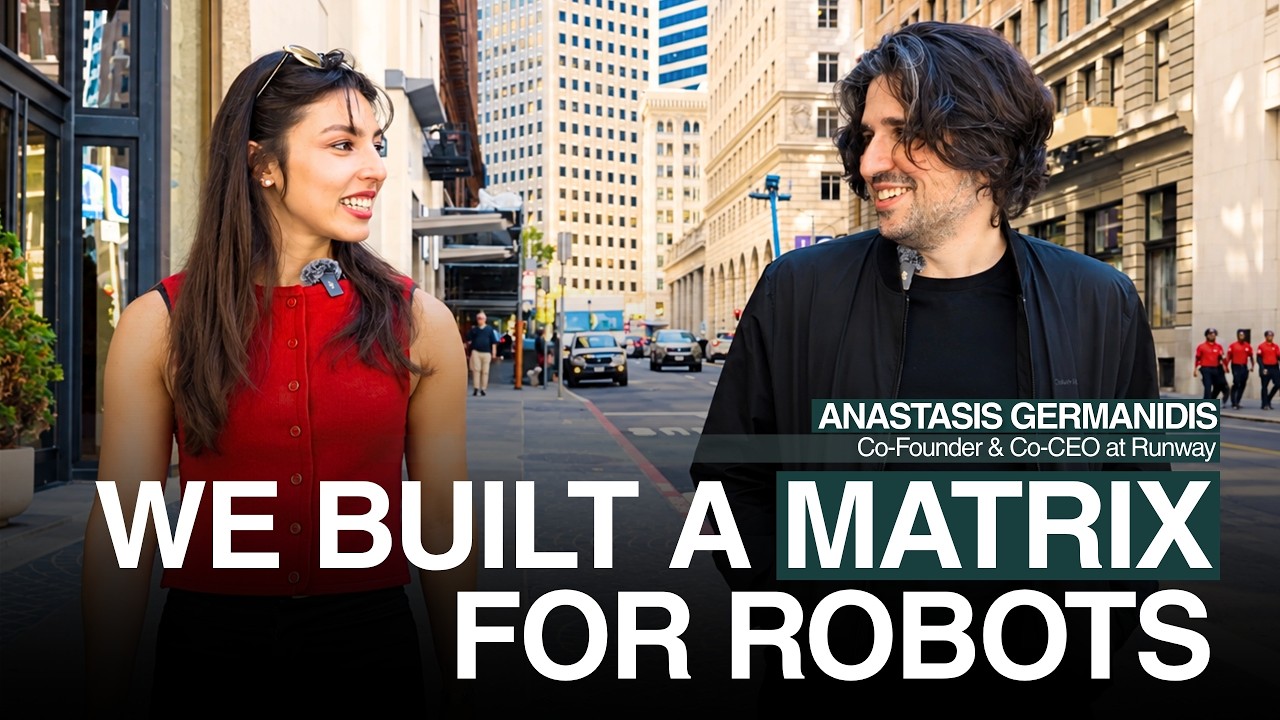
Today I walk with Anastasis Germanidis, co-founder and co-CEO of Runway (https://runway.com). Anastasis met his co-founders at NYU's ITP art program, built Runway into an AI video company doing over $200M in annual recurring revenue at a $5.3B valuation, and recently acquired the Paris-based Kinetix team into Runway, and now he's pushing Runway's video models into world models for robotics and software. He gets into the hour of existential crisis after OpenAI launched Sora, and how the team shipped a better model within a few months.
- How Runway accidentally built one of the best models for robotics by teaching a video model to predict pixels
- Why he defines AGI as something that can never be reached, and why folding clothes is still harder for AI than the tasks people call complex
- The 2022 call to drop the entire product and build 30 magic tools in 30 days
- OpenAI's Sora launch, the hour the company asked if it could compete, and shipping Gen-3 at CVPR a few months later
- Why proof of work beats credentials and big-lab resumes when Runway hires
Chapters
- 00:00Trailer
- 01:21Anastasis Germanidis, Co-Founder & Co-CEO, Runway
- 02:27Accidentally building one of the best robotics models
- 03:04The camera control that led to world models
- 07:18How video models train robots and self-driving cars
- 10:47What a world model actually is
- 12:10Pitching world models to a 30-person team in 2023
- 16:19Why folding clothes is still unsolved for AI
- 17:37Why AGI can never be reached
- 19:13Learning to code from his sister's professor
- 22:03A game built on Nietzsche's eternal recurrence
- 30:35Starting an AI company from art school
- 35:44The book every Runway hire gets
- 39:47Why staying in stealth is counterproductive
- 42:0330 magic tools in 30 days
- 46:01Keeping the team smaller than it should be
- 52:35Fueled by being underestimated
- 55:55Sora's launch and an hour of existential crisis
- 57:02Racing to beat Sora in three months
- 1:01:56Solaris and software generated in real time
- 1:05:15Why AI labs pay for fake versions of Amazon
- 1:08:27Video requests cost 100x more tokens than LLMs
- 1:09:52Why Sora struggled as a consumer app
- 1:16:30Hiring on proof of work
- 1:19:44Becoming co-CEO with Cristóbal Valenzuela
- 1:21:21The cost of being a full-stack AI company
- 1:29:39Would he live the same life again
- 1:30:56What he's still becoming
- 1:32:52Outro
About the guest
Full transcript
LubaAwesome. Anastasis, thank you so much for coming on the show.
AnastasisYeah, good to be here.
LubaWell, congratulations on crossing $200 million ARR and also acquiring Kinetix, the Paris-based robotics team.
AnastasisThank you. Yeah, we're very excited by both.
LubaSo you guys are all about real-world intelligence these days. Tell me more. What is real-world intelligence?
AnastasisYeah. So the models that we're building, like one of our beliefs is that in order to learn about the world, you need to directly observe it instead of learning from how humans talk about the world. So, you know, at Runway we've been building video generation models at this point for almost a decade now.
And we realized pretty early on that when you're teaching models to predict pixels and predict video, you're also teaching them to predict how the world works. You're teaching them about the physics, you're teaching them about, like, all the kinds of tasks that humans care about, and how people move in space.
And so what we kind of realized is that, you know, we were building those models for a while that have been used by filmmakers and artists and marketers to create video, but also we accidentally created one of the best models for robotics by just building a model that can predict video well. And so we've been really now focusing on how do we expand the application of our models and make them useful beyond creating content.
LubaSo you said that you realized that pretty early on. Take me to the moment when you had that realization.
AnastasisYeah. So I remember one of the moments that was very formative for this direction of world models was — so we released our first video model back in 2023. That was Gen-1, and Gen-2 were kind of released in quick succession.
LubaYeah, I remember that. It was a really exciting moment, because I think none of the other labs had such a good model.
AnastasisYeah. So I think it kind of created the whole wave of, like, AI filmmakers and AI video. And at the same year we did our film festival. So it really was, like, the genesis of, I think, AI video as a category. But I remember one of the first kind of controls that we built on top of the model.
So we were interested in, like, you know, how would a film director use a video model? Obviously, you know, they want to describe what's happening, but a director would want additional control. They would want to decide, like, exactly what should be the camera direction. So we built these camera controls on top of the models. And the moment we built this —
LubaSo what does that mean exactly? It means that the camera that is in the model is directed so that, you know, the world around it —
AnastasisExactly. Yeah. So you can essentially direct the camera in the scene, so you can determine exactly how the camera should move. But the moment we did that, there was, like, a kind of light-bulb moment where it's like, it's almost as if you're navigating a world.
LubaKind of like first-person shooter games.
AnastasisYeah, exactly. So it's not just that you're creating, like, a piece of — just a single shot of video. It's more like you're creating this glimpse of a universe that's just created, that's created and then destroyed in the span of, like, a few seconds.
LubaAn analogy that comes to mind is as if you were holding a lighter, and then you were lighting up something ahead of you, and then the scene disappears as soon as you pass through the light, right?
AnastasisYeah, that's a nice way to put it. And so I think at that moment, when we released camera controls, I think it became more clear that, you know, you're essentially almost, like, simulating a world by generating video. And it was very similar to, you know, the language model world, where the early models could barely generate a coherent sentence.
Similarly, the early video models could barely generate, like, motion. But if you could extrapolate from there and say, okay, what happens, like, five years from now if you continue to scale those models? And they're going to learn better physics, they're going to learn more about how the world works. And so they're going to become powerful simulators of the world.
And so I think what we've generally been trying to do for the whole company's history is, like, just taking a glimpse of something and then saying, like, what does the maximal version of that look like? Like, if we continue to push in that direction for the next, like, five years, what's that same technology going to look like in five years?
LubaWhat do you think it's going to look like?
AnastasisEssentially indistinguishable simulators of the world. So, like, you're going to be able — we already are seeing that with some of the videos generated by our models. We run some user studies and kind of ask people to pick, like, a real video from a generated video, and in a lot of cases it's actually hard to pick apart, like, what's generated and what's real.
But what's going to change in five years is the whole thing is going to become interactive. So you're going to be able to not just watch a video that feels photorealistic, but actually be able to navigate in a world that feels indistinguishable from reality. And once you have that powerful simulator, you can use it for all kinds of different things that we think are going to be very, very valuable to the world.
LubaGive me some examples of what things this could be used for.
AnastasisSo robotics is a big focus for us. Like, we think, you know, if you start from a model that can generate video well, you can use that same model to now both create synthetic data to train robots — so you can generate examples of, like, robots performing different tasks and feed that back into robotics training — and you can use the same video models as well to decide what actions a robot should take in the world. So you can predict the outcome of different actions that a robot should take. Let's say you can solve, like, very complex manipulation tasks.
So that's an area that we've been investing more in on the robotics front: how do you start from the same underlying models and the same kind of foundation and use them in very different ways in robotics? And yeah, the hope is that, you know, by having really powerful robotics models, those models should be able to generalize a lot better than traditional robotics.
So traditional robotics can fail when the environment changes even, like, slightly. But models that have learned from a massive amount of video are able to handle all the unexpected scenarios that the real world kind of inevitably has. Like, if you want to build robots that are able to, you know, live in your house and, like, basically be able to handle, like, the layout of a specific apartment, be able to handle all the complexity of the daily tasks that they have to do, then you need models that have this, like, level of intuition, kind of similar to how, like, human intuition is able to handle unexpected things that happen.
LubaAnd my understanding is that level of intuition gets developed by a combination of synthetic data and real-world data. And so world models, models that Runway is developing, are going to be really helpful with creating a lot of synthetic training data.
AnastasisExactly. So our models can be used to create synthetic data. So they can be used to — you know, like, one example is, let's say you want to build self-driving car models. Most self-driving footage, or most driving footage, is very boring. Like, it's just moving forward, like —
LubaIt's not edge cases, like what happens in an unexpected scenario, as you said.
AnastasisExactly. Yeah. So if you want to have, like, difficult weather conditions, if you want to have, like, kind of accidents, those are data that's very difficult to collect, and it's a tiny, tiny percentage of the overall driving footage that's out there if you're collecting driving footage. But it's data that you can very easily generate with a video model.
So we hope that video models essentially allow you to make robotics and, like, self-driving models much more robust, because they can learn from all this diverse set of cases that are difficult to simulate otherwise. So it's essentially, like, a massive multiplier of data that you already have.
LubaAnd what is a simple definition of a world model?
AnastasisSo a world model — like, the definition I like to use is just a simulator of an environment. So it's a way to have a model simulate what happens if you do specific actions in an environment. And the environment could be as simple as, like, tabletop manipulation, like your sink. The environment could be a virtual world. The environment can be, like, the roads.
So it's essentially simulators that allow you to understand cause and effect. You can understand, like, if I do this action, how will the world change, versus if I do this action. And if they're able to simulate that successfully, then they're world models.
In my mind, world models are something that video models become at, like, a certain scale. Like, once you get a level of capability where the models are able to simulate success and failure in a specific environment well, then they're able to become kind of world models of that environment.
LubaDid you have this insight right off the get-go, or is it that at some point you realized that and were like, holy shit, this is so much bigger?
AnastasisYeah. So it was around the time, like, 2023, when we were building our early video models, that it became clear that the applications of those models were, like, much more vast than we anticipated. I remember we had this off-site, I think, that we did in 2023, in September 2023.
LubaAnd how many people were you guys at that point?
AnastasisWe were maybe 30 people. 30 or 40 people.
LubaAnd now you are…
AnastasisNow we're, like, 230.
LubaGot it.
AnastasisYeah. And it was the first time that I talked about world models to the company, and I think it was a bit of a confusing talk to people. It was almost like a new point of view on the same underlying models that we were building. But obviously the core and starting point of Runway has been filmmaking, and, like, how do you use those models for creative applications to tell new kinds of stories? That's still a very big part of Runway and what we do. But that was the association that most people had about, like, what are the models useful for, right?
So this was a different perspective that we had been discussing on the research side, but this was the first time that it was kind of communicated as, like, this is the direction that Runway is going: towards world models.
LubaSo it sounds like it was pretty immediate after the launch of the video model — you had that click.
AnastasisYeah, it was very early on. It was within a few months of that.
LubaAnd so how did people take it? So it was a little confusing, and then…
AnastasisAnd then I think there were a lot of discussions on, like, how do we first kind of approach this research direction. And we initially built a small team on the research side just to focus on world models, and then the rest of the company was still focused on, like, let's keep pushing, you know, all the work that we're doing on creative applications of those models.
But yeah, over time — like, very quickly, I think — the team was pretty bought in. And, like, I think that vision also really resonated with new folks that we brought on the team. I think initially there was a lot of skepticism that video models could be — you know, if you looked at the video models of 2023, you had to convince yourself that, like, actually, in the future those models are going to become powerful simulators. But there's probably a lot less skepticism now of that, I would say.
LubaAnd I heard you also say that the path to AGI is not going to be through LLMs. It's going to be through world models.
AnastasisYeah. AGI is a bit of a loaded term at this point.
LubaAnd actually, on that: what is your definition of AGI?
AnastasisApparently it was just solved a few days ago, so…
LubaOh, damn. Okay, wait, I missed that. Tell me.
AnastasisNo, there was some discussion about GPT Astra —
LubaOh, yes. Yes.
Anastasis— being AGI, but…
LubaBut I think with every release of a model, someone has a whole conversation and argument about the fact that that's AGI.
AnastasisI think one of the original definitions of OpenAI was the models that can do, like, you know, the majority of economically useful tasks in the world. But if you look at the current models, they're not able to interact with the physical world around them in a meaningful way. We have some initial signs of that, but I don't think we're anywhere close to being able to solve real-world kind of tasks end to end.
And there is this idea of, like, Moravec's paradox, which is the things that people consider to be complex and difficult tend to be some of the things that are solved the earliest by AI models, and the things that people consider to be very easy to do…
LubaKind of like folding clothes and doing very simple tasks.
AnastasisYeah. Folding clothes, like, even opening a door, like tying shoes — those are very difficult and complex to actually solve in any kind of generalizable way.
LubaI think it's an interesting parallel to life, where the simplest of truths are the hardest to implement.
AnastasisRight. Yeah, I think it definitely tells something about humans and, like, also cognition, because, like, it's like we've basically — I think the bias is that if we're consciously aware of, like, how we're solving a particular problem, then we tend to consider it to be more difficult. If we're doing something subconsciously, then we assume it must be simple. But there is, like, all this…
LubaProcessing that goes on to make it happen.
AnastasisExactly. Yeah.
LubaAnd so, coming back to AGI: that was the official OpenAI definition of AGI, and you started with "AGI is a loaded term."
AnastasisYeah.
LubaHow would you describe what AGI is in your mind now?
AnastasisSo yeah, I think we're nowhere close to fitting that definition of AGI with the models of today. I would say also, like, the goal of AI should be to give people, like, almost superpowers. You know, humans have evolved together with technology. Like, what humans can do today with the tools of today versus what they could do, like, 100 years ago or, like, 200 or 300 years ago is completely different. Like, humans are a tool-using species.
And so to me, I like the definition of AGI which is, like, it can never be reached. Like, it's always asymptotic, because humans are also evolving all the time.
LubaThat's very interesting. Okay.
AnastasisSo we're never going to reach AGI, because we're always going to — you know, we're going to build better AI systems, but then they're going to be part of, like, the human capability, and…
LubaRight, we need to continue expanding.
AnastasisExactly. Yeah. So I think, you know, humanity is always going to evolve. And, like, I think we've discovered, like, 1% of what it means to be human — is, like, one way of putting it. Like, there's just so much more of what humans can do that we haven't discovered yet, and we're discovering it partly by building new technology.
LubaSo, bringing it back to the human — on the show, I love focusing on the human behind the build, and I want to bring you back to where you're from. You grew up in Greece. What were you like, and what were you interested in?
AnastasisWhat was I like? I was always a very quiet kid. I think I was both interested in — I guess to no one's surprise — both technology and art from a very young age. Like, I learned to program when I was maybe, like, I want to say 10 or 11 years old, by convincing my sister's professor to teach me programming.
LubaOh, wow. How did you have access to your sister's professor?
AnastasisSo my sister is six years older than me, and she was kind of giving, like, the Greek national exams, and had a professor that was kind of helping her with, like, the computer science exam. And so I kind of convinced him to start teaching me how to code after the lessons were done.
LubaThat's awesome. And why were you interested in learning how to code at that age?
AnastasisI was pretty obsessed with computers. I think, yeah, it started from, like, playing a lot of video games and just being interested in — like, then I wanted to make my own video games. I think that was the initial reason I wanted to learn programming. I played a lot of simulation games. So, like, I was a big fan of The Sims.
LubaVery fitting. A lot of simulation games.
AnastasisI remember this one game that I was very obsessed with called Aerobiz. It's a simulation game for, like, managing airlines.
LubaInteresting.
AnastasisIt's, like, maybe the most dry subject for a simulation game, but I remember playing that for, like…
LubaWhy were you obsessed with that game specifically?
AnastasisThere was something about — I don't know, there's something about simulation that's always appealed to me. Like, just this idea of being able to rehearse scenarios before going out in the real world and doing those scenarios, and also being able to experience things that were out of reach. Like, I was a ten-year-old managing kind of airlines in this game.
And then I had, like, a very specific game that I wanted to build that was — yeah, I think at that point I was just very interested in philosophy, and, like, making a game around philosophy.
LubaAnd when you say at that point, how old were you at that point?
AnastasisSo I think I started by making some, like, smaller initial kind of games, like, I think around, you know, 11, 12 years old. That particular game that I got kind of obsessed to build was maybe around, like, 15. So it took a few years of just, like, doing small coding experiments.
LubaAnd probably also becoming more interested in philosophy.
AnastasisYeah. So I was interested in philosophy and, like, also music and a bunch of — just, yeah, I don't know. I think always, like, just the idea of creating art and writing code always felt like different forms of creation, essentially.
LubaWait, we can't skip out on this philosophy game. What was the premise of the game?
AnastasisYeah. So it was based on — so I think maybe the closest analog was, have you watched the film *Groundhog Day*? So the whole idea was, it was based on, like, Nietzsche's idea of eternal recurrence, which is the idea that you basically — it's almost like a thought experiment of, like, if you had to live your life again and again, would you choose to live your life or not?
LubaAnd would it be — would you choose to live your life, or would you choose to live your life in the same way?
AnastasisWould you choose to live your life in the same way, or, like, would you do the same things?
LubaRight. Would you make the same choices?
AnastasisAnd so it was kind of a play around that. Like, it was this idea of, like, you were basically living the same days again and again and, like, had to kind of make some particular choices along the way. It's a long time ago. It was a very weird idea, I think. But I remember vividly, like, trying to build this game for a while. But yeah, games were, like, the main reason I started learning how to code.
And then I think maybe around, like, 15 or 16, I came across, or someone gifted me, a book about neural networks. And that was the first time I kind of became more interested in AI, and then tried to kind of learn more about that.
LubaAnd from my research, it sounds like there were multiple times in your life when you were interested in these more philosophical questions and topics, like identity here. Would you make the same choices about your life? Where does this interest in the bigger questions about life come from?
AnastasisI'm Greek, so probably from the ancient Greeks. I don't know.
Yeah. I mean, it's hard to pinpoint those things. I think I was reading a lot of books as a teenager and, like, became very interested in philosophy and understanding — I think, you know, trying to understand death, I think, maybe was one big theme. Just trying to understand, like, how we know about certain things. Like, I think for a long time growing up, I was just constantly kind of questioning different things I was learning. So I became very interested in, like, philosophy of science and epistemology, and kind of trying to understand, like, how do we come to acquire some knowledge about the world, like, invent some theory about the world.
But yeah, it's hard to find, like, what is the origin of that. It's just — yeah, I don't know.
LubaAre you questioning a lot of things about how we acquire knowledge and how we live our lives now?
AnastasisMy day job keeps me busy, so…
LubaDon't have a lot of time for questioning.
AnastasisI do think, ultimately, in AI there is — you know, like, developing a research thesis involves — like, there's definitely a lot of that early philosophical interest that has influenced, like, how I approach problems today. Again, like, the interest in simulation, I think, has been a big, big, big theme of my life for a long time.
LubaYeah. To bring it back to that essay on identity. So for anyone listening, that essay was about identity. The thesis was kind of like: having an identity can be constraining to your life and choices. And I thought it was interesting that you always kept this identity of an engineer and an artist, and I'm sure there are other identities to you. Do you still believe that having a set identity is constraining to what we can achieve?
AnastasisYes, I do think so. And, like, I think we've seen that in the company as well. Like, a big part of, like, hiring at Runway has been finding folks that, you know, might not look, like, extremely impressive on paper, but, like, giving them the chances to prove themselves and being, you know, validated when we do that. And learning being, like, a core principle of Runway — like entering new fields, like, you know, starting from art school, which is not where AI companies tend to start, and, like, building a research org from there, and, like, constantly evolving what we do as a company.
I do think some of it is in how we built the company — this idea that people are capable of learning new things more than others think they are, and organizations are able to evolve far more than, like, people from the outside might think that they can. So I do think, like, that belief that people are more capable than they think does inform a lot of, like, how I think about hiring, management. It's just, like, giving people the right chances, and, like, in terms of kind of, you know, giving them tasks that go beyond maybe what they're currently doing, go beyond their kind of, you know, job description, and then seeing — yeah, people can be surprised by themselves and what they're able to accomplish.
And I think I've seen that again and again in, like, my time at Runway. Like, there's a lot of people that have started from, like, one role and kind of transitioned to another, that have come from maybe more of an engineering background and became researchers, and vice versa. Like, that's something we celebrate a lot: this idea of, like, kind of following your curiosity in the organization and kind of moving, and, like, deciding your path in a lot of ways. So yeah, I think that early philosophy has carried its way, like, in some ways.
LubaYeah. I think that idea of giving people a chance is super impactful. And I think it's a combination of following your curiosity, but also recognizing and giving someone a chance to follow that curiosity. And, as you said, making people believe that they can achieve much more than what they think they do. So you almost have to have that permission, and someone telling you that you can, to actually believe in it yourself.
AnastasisYeah, I totally agree. Something we've seen again and again.
LubaI want to come back to, you know, how you guys built a research team having a very unconventional background, because the three of you, the co-founders, come from an art background, and you're immigrants, and you didn't have that traditional Silicon Valley story. But coming back to you: so you went to art school. You previously were trained as a computer scientist and an engineer, and then you meet your co-founders at NYU ITP, and you guys decide to go and start a company with the idea of building video models. What were the hopes and dreams for Runway then? What was the vision?
AnastasisSo very early on, I think we developed this — like, there is this North Star of — you know, we were obsessed with generative models of the time, which were very, very primitive in some ways. Like, you could generate images, but they were very low resolution, very pixelated, very distorted. But we had this North Star vision of, like, if this technology improves, you're going to be able to, you know, generate, like, two-hour feature-length films with the same underlying models, by just, like, improving the technology.
And so a lot of the early days of Runway has been, like, first of all, how do we get those models in the hands of artists and filmmakers? Like, we worked with a lot of — there was this small community at that point of creative technologists and kind of artists tinkering with technology, or, like, using code to make new forms of art. And so that's the community where Runway started. It's like, first, let's just give access to the available technology to artists and then see what they do with it.
LubaAnd what were some examples of what they did back then?
AnastasisIt was a lot of interactive art, I would say, early on. So, for example, people were building an interactive mirror that would take camera feed and then translate it into a stylized, or, like, painterly style. Or, like, you had models that could do skeletal tracking and then allow you to kind of paint with your arms, or things like that. So they were building a lot of interactive media, interactive technology.
And we very quickly realized — like, the three of us kind of call ourselves fellow filmmakers, because film was part of our background in some way or another. And so we…
LubaDid you actually want to be a filmmaker?
AnastasisSo when I went to college, I initially was planning to major in neuroscience and film. And then I realized that, you know, first of all, I did not enjoy the amount of, like, memorization that neuroscience required.
LubaNeuroscience required.
AnastasisAnd then what I really liked about coding and programming, which I was doing earlier than that, was just this idea that you can build something in a day and have, like, this very quick iteration loop.
LubaYeah.
AnastasisAnd film, to me, felt like it would just take so long to actually get from, like, your idea to a final output. And so while I love the medium of film, I did not like the latency from, like, idea to output — which is probably what those models now allow you to solve for. It's like you can turn your idea into a final output very quickly. But so then I ended up just studying computer science.
LubaAnd why was it neuroscience and film? That's such a weird combination.
AnastasisRight. So in neuroscience, a lot of it came from, you know, my interest in neural networks and understanding, like, the goal of — you know, if I understand more deeply how the human brain works, then I can apply some of that in, you know, building new kinds of AI systems. And then film, I think I just always loved film as a form of storytelling.
Yeah. And so it wasn't, like, top of mind for me to combine the two. It was more like…
LubaYou were following your curiosity.
AnastasisI wanted to make films, and then I wanted to, you know…
LubaStudy the brain.
AnastasisStudy the brain to apply to AI. But it was not clear to me at that point how I would end up combining those two things. I was just very passionate about both topics.
LubaIs that how you've generally been living your life? Kind of, like, following the curiosity in the moment and then hoping that it's all going to unravel in the best way possible?
AnastasisWe had this book, actually, that we gave to every new member of the team at Runway. It's a book called *Why Greatness Cannot Be Planned*.
LubaOh, I haven't heard about it. Who's the author?
AnastasisSo the author is Kenneth Stanley, who's an AI researcher who kind of studies open-endedness. He was at OpenAI at some point. The main topic of the book is, like, very often being too goal-oriented tends to actually lead to suboptimal outcomes. Like, sometimes the best way to get to a big discovery, or, like, a great outcome, is to, you know, follow this idea of, like, stepping stones. Like, just follow your curiosity on, like, the immediate next thing. And then eventually that actually tends to be a much better path than, like, having a very strict, rigid plan about how you're going to accomplish a big project or get to a big discovery.
And I think that has been part of Runway for a long time. Like, even, you know, we had this idea that we're going to get to a two-hour, feature-length film using those models, but we started very small and, like, incremental. And we had no choice, 'cause, you know, we were nobodies from an art school. So we needed to prove ourselves and, like, make things continuously and tell the world that we exist.
But that has — I mean, obviously now that, you know, the team is larger, there is more emphasis on planning, and especially for, like, you know, training a new big kind of base model, like, you need to prepare for months. But some of the same spirit of, like, moving quickly and then kind of figuring out, like, what's the thing that's kind of immediately useful — that still remains. And I think people in general, in my mind, still underestimate the importance of speed, and just learning from just doing, and trial and error.
LubaYeah. I feel like there's so many parallels to that philosophy of focusing on the present moment, following your curiosity, to also simulation models and world models, because obviously you're developing the world around you by seeing what's happening in the present moment as well. What have you found is that art of both speed, curiosity, focus on the present, and planning, now that you are a much bigger company — over 200 people — and obviously you're making a lot of money and you have to plan?
AnastasisYeah. So there's a lot of things that benefit from long-term planning. Like, you know, if you're going to grow the size of the organization and hire a lot of people, you need to think ahead, like, quite far ahead. But for a long time, like, I would say the longest-term plan we had at Runway was, like, at some point in one of the early years, where, you know, we decided, like, we were going to become a mature company, and, like, start to have, like, quarterly planning, and, like, kind of…
LubaYeah, yeah. When did you decide you were going to become a mature company?
AnastasisI think that was in, like, 2020 or 2021.
LubaOh, so a while ago. Okay. Would you say you're a mature company?
AnastasisAnd then we immediately realized that was not the way for us.
LubaOkay. Is that now the way, or not really, six years in?
AnastasisWe still — I would say, you know, again, like, some parts, I think, require long-term planning. But for the most part, I think the future is very difficult to predict. And it's very — like, even as we think about long-term vision, it's very important to think, like, how is this useful, you know, in the next weeks or the coming months? Like, what is the first immediate thing that this can be applied to? And I think that keeps you kind of grounded.
It's very easy, I think, to convince yourself of things that are, you know, not the right direction if you — you know, there are companies that stay in stealth for, like, years. And, like, I think right now, with, like, the boom of AI companies, there are some companies that can, you know, raise a lot of money and then stay in stealth for a long time. But I do think that ultimately can be counterproductive, because facing reality is very useful. Like, facing, like…
LubaYou've got to run experiments in the real world.
AnastasisYeah. And so, yeah, I mean, the goal of world models is, like, how do you run experiments…
LubaIn the real world.
Anastasis…much faster than you otherwise could.
LubaYeah. I wish we could simulate our own human experience. But then, as I said that, I'm like, do I wish that we would be able to simulate our human experience? Would it be less exciting?
AnastasisI don't know. I mean, we might be in a simulation right now, so…
LubaThat is true. So make this a little more tactical for me. So you guys, say, do the long-term plan. Let's say you set whatever your goals are for the next quarter or the next half a year. How do you stay malleable and flexible enough to drop those plans if you find some new information about where the industry is going?
AnastasisI think some of it is just encouraging people — encouraging a lot of ownership in everyone that we bring into Runway. Like, there is this idea that, like, everyone is — like, the thing I want to avoid the most is, like, someone comes into the company and thinks this is, like, an established organization, and, like, "I'm going to continue to operate the machine that's working." Like, everyone should feel as if, like, it's a constantly evolving, dynamic company.
And then some of it, I think, has been just, like, over time — you know, there's a lot of points in the history of the company where we had to adapt very quickly, and we try to tell those stories to new folks that are coming in: why that was so important for the company. So, you know, there was a time that we realized that at that point, the image generation models had just started working really well. I think it was around 2022. And we decided to just drop the entire product that we were working on, and then we said, like, we're going to just build, I think, like, 30 magic tools in 30 days. That was the mandate. And, like, we switched a lot of, like, what the company was working on to just focus on that, and that ended up to be very, very successful.
LubaWait, tell me more about that. What does it mean, 30 magic tools in 30 days? What was the mandate? What were people actually working on?
AnastasisSo for a long time in the history of the company, we were building — like, the early days of Runway, when we were building this video editor product. So what was happening is we were doing research in generative models, but it was not ready to actually bring into the product. Like, the results were not that good. And then we were building this series of tools that were useful for particular video editing tasks and, like, VFX use cases.
And there became a moment around mid-2022 when image generation suddenly became really good. And there were at that point, like, Latent Diffusion, Stable Diffusion, DALL·E 2. There were a few models that were, like, high-resolution images that actually looked real. And it was the first time that you could get to this level of quality.
And so we immediately kind of realized that, okay, there's something different that's happening with those new models. And, like, we don't know exactly what the right tools to build are, but we need to find out as quickly as possible. And so we essentially set the goal of, like, in the next 30 days, we're going to build 30 tools around those models, and we're going to figure out what those tools should be. And then we went and built those tools.
LubaSo it was almost like a 30-day hackathon. Every day there is, like, a mini demo day where people present their tools.
AnastasisExactly. Yeah. So just, like, this very quick iteration, and very quickly trying to figure out, like, what are the right tools to build on top of those models, 'cause it was not obvious.
LubaObvious. Yeah.
AnastasisAnd yeah. So, you know, like, I think this flexibility tends to be really important, and, like, I hope we're able to maintain that to some extent, especially as we scale the company — of just being able, if something is changing in the market, if we realize something about the latest models that we build, how do we make sure we don't miss out on those opportunities?
LubaAnd just to reiterate: the way you're going to not lose that flexibility is by telling stories about the times when that happened to people who joined the company, to people who have already been at the company, reminding people that this is not, like, a set, "we have figured everything out" workplace. Anything else?
AnastasisYeah. So I think, yes, storytelling has a big role to play. Like, just making sure — I mean, we're a company about — you know, filmmaking is, again, the core of the company. So we tend to have an onboarding where we show people, here's, like, what the first generated film looked like a few years ago, and here's where we are today. So just that — I think it's very important to contextualize, like, what was the progress that we saw over the past five years, and, like, what were the turning points that ended up really mattering.
And then beyond that, I think on a day-to-day basis, I think it's just, you know, maintaining that ability to move fast and, like, have as little additional process as possible. And always, almost, like, the team should be smaller than — you know, like, we always try to be smaller than we should be, is, like, one way I like to put it. Like, we should always feel like, you know, if we brought in more people, we'd be more productive. I think that's a good state of being.
LubaHow do you measure that?
AnastasisSome of it is just, we say, intuition.
LubaIntuition.
AnastasisYeah. I don't think we have a particular way of, like, measuring that directly. Yeah.
LubaDo you feel like your intuition with the rest of the leadership is similar, usually?
AnastasisYeah. I do think, like, the three of us co-founders, we definitely wanted to keep the company small for a long time while we were figuring out — like, we always felt it was important to first figure out the identity of the company and who we were, and, like, get the product to a certain state before we started kind of massively scaling.
I think we're at a point now where that's making a lot more sense. Like, you know, the enterprise adoption of those models has really grown, like, very, very quickly over the past year. And so we need to scale the team to be able to capture all that interest and make sure we're able to kind of scale our business. But at the same time, there's definitely this bias that, like, we should not grow headcount for the sake of growing headcount. Like, it's very important to be very intentional. Like, we still interview everyone that's in the kind of hiring process.
LubaYou personally, with the co-founders?
AnastasisYeah.
LubaThat must be taking up a lot of your time.
AnastasisYeah, but I think it's worth it. And I think it's also important both in terms of — you know, like, part of it is as an additional filter, but part of it is it's important to make the company still feel small enough that, like, a person that's joining the team can feel they can go direct, if they need to. So it solves kind of for both things.
LubaI want to come back to this idea of being flexible and curiosity-driven, and planning, for you personally. Because through your life and career up until this point, it sounds to me like you've been really curiosity-driven, and you're kind of like, okay, let the world unravel in front of me based on the inputs in real time. What has it cost you to now be a little more planning-oriented?
AnastasisThat's a really good question. So I think, yeah, I've always been — you know, there were, like, two opposing, almost, forces in my life. One is, like, having very specific ideas and themes that I wanted to pursue. So, like, all the projects — even before, when I was working on a lot of different projects, a lot of them were about identity, simulation. Like, they were kind of the same recurring themes. But at the same time, I think in some ways, you know, I had, like, at any given point, like, 50 different projects I was working on. And I think there's been a lot of benefit in actually focusing on one specific thing for a very long time.
And I think there's still an element of, like, you know, every day in a company is different. Like, what makes startups so exciting is, like, this ability to compress years or months into days. And so there's just so much variety in, like, what we do daily that it doesn't really feel like a compromise as much. Actually, in a lot of ways, it kind of allows me to take ideas much further than I could before, when I was kind of an individual making small projects.
So I make, obviously, way less art — no art at this point. Like, there's no time for making kind of a lot of personal projects. But it's still pretty gratifying, because we kind of allow other people to kind of express their imagination.
LubaSo obviously now the company is much bigger, and your days are filled with a lot of different problems and a lot of different tasks that you could do. But I'm sure it was not like that at the very beginning. It was just the three of you guys working on one model, one type of research. So what was it like for you in the early days to stay so focused?
AnastasisSo, I mean, in the early days there was just so much to do and so few people to do them. So I think that's what allowed us to maintain focus — the fact that there's just…
LubaA never-ending to-do list.
AnastasisYeah, exactly. And we had to — you know, it was one of those things where, like, there was nothing that would automatically happen. Like, everything that would happen in the company was as a result of, like…
LubaYou actually doing the work.
AnastasisUs doing the work. Which, you know — in some cases today, there's obviously a lot of — I think it's very important to stay hands-on. But, like, at that point in the beginning, it was like we had to move the company forward.
And so, I don't know, even at the early days, I think this idea of, like, proving ourselves — especially because, you know, we came from this nontraditional background — I think was definitely a motivator early on. Of, like, proving to the world that, you know, we can build this, you know, really impactful company.
I think we do generally get fuel from being underestimated. Like, I think at this point I really enjoy when there is, you know, someone out there that's, like, underestimating us, or doesn't think we can accomplish something new. Or, like, especially, you know, when we're entering a new area — when we're expanding the business towards world models, when we're expanding towards robotics, all those new areas — I think, you know, I've found a lot of motivation from people thinking, like, we're not able to do X or Y, because we're not experts in this. And so I think, yeah, different motivations for different types of the company, I would say.
LubaYeah, the motivator of proving someone wrong is definitely a huge one. Maybe even bigger than the motivator of proving yourself wrong, because there are so many more opinions and people that can fuel you, versus it just being yourself.
AnastasisYeah. And, I mean, I think a lot of it is also just, like, passion for what we're doing and what we're building. Like, with some of those — you know, the beauty of, like, those large-scale models is that, you know, there's this analogy that those models are not designed, they're grown. Like, you're putting all this compute and data into building those models, but then you don't quite know — like, you kind of know what you're going to be able to accomplish with them, but they're very surprising in a lot of ways. And so there is that element of, like — it's very satisfying. Like, it satisfies our curiosity to figure out, like, what is going to be the outcome of this thing, that…
LubaWhat will it do?
AnastasisAnd I think that's the beauty of research. Some of it is, like, you're pursuing these directions and these beliefs for a long time, and so it's very important to kind of be a bit stubborn about specific ideas. But the path you're going to take to get there is always very surprising. And so, you know, it's very important to kind of keep an open mind when you find out something is working better, and not be too dogmatic about, like, "this is the path that we're taking, we're not going to update as a result of this new finding."
LubaSo, speaking of being underestimated: obviously there are a lot of huge labs competing in the same space as you guys. How were you able to build a research team that put out one of the first video models, that is now putting out one of the first world models? What has that process been like?
AnastasisYeah. Again, like, I think there has been an element of — yeah, this has been motivating for the team. Like, I remember…
LubaDo you guys recruit for the trait of whether you're being motivated and fueled by being underestimated?
AnastasisNo, not specifically for that. I think there's enough of that inside the team already, so we don't necessarily need to hire more of that. But I do think there is an element of — you know, one of the times in the company that I remember the most is when we released Gen-3. So that was a year after what we talked about earlier with, like, our first video models. And there was this model that OpenAI released, Sora.
LubaMm-hmm. It was actually one of my questions — what it felt like when Sora got released, for you guys.
AnastasisYeah. So at that point, when it got released — you know, OpenAI in 2024 was — you know, they're obviously a formidable company today. But at that point, there was no one really competing with them. So Gemini had just first come out. I think Claude was still at the very beginning. So they had no real competition in LLMs. So them entering video generation, and entering video generation with something that looks extremely strong — like, the results from Sora at that point were much better than what we had at the time — was definitely… yeah, there was, like, an existential crisis for maybe an hour or two, where it's like…
LubaJust an hour or two.
Anastasis…can we actually compete against OpenAI? But at the same time, it was the best gift that we've ever received as a research org, because it kind of accelerated our roadmap. Like, you know, it compressed it to — basically, we need to figure out how to build a better model than Sora in the coming three months. And so we kind of rallied the whole company, and the whole company kind of rose to the challenge.
And I think that was my favorite project, because at the end of it, people — again, to our discussion earlier — figured out that they're more capable than they think. I think, you know, when we started out that specific project, I think there was definitely a lot of uncertainty from people. Like, are we actually going to be able to — you know, do we have the resources, or do we have the skill set, to actually win against Sora? And at the end of it, people figured out that we in fact did, and we put a model out there that was better than Sora in a few months.
And I remember we released it at CVPR, which is one of the big computer vision conferences, and it was very gratifying for the team that, like, everyone was, you know, talking about Gen-3 and the model that we released. So I think it was one of those formative moments of the company, where people, you know, realized that, like, you know, if there's a challenge ahead of us that might seem insurmountable — and a lot of people at that point believed, like, Runway is over, like, there's no way Runway is going to be able to compete against Sora — the fact that we kind of proved them wrong, and, like, people really internalized that message that they're more capable than they think.
And I think that has become a very important kind of piece of the Runway history. And as we enter those new frontiers and new fields, I think that, you know, we have a lot of, like, precedent for beating the odds and, like, you know, becoming experts in a new field that we were not experts in.
LubaAnd this also ties really well to what you said about showing people what is possible, because it sounds like Sora was a better model than what you guys had. And perhaps for the team and for you personally, besides, like, "can we rise up to the challenge," it was also, "hey, this is possible, so we've got to make it happen and get better." I was just thinking, there are so many examples in my own life where I just needed to see an example of something to be inspired by it, and also be fueled by it, with that positive momentum and inspiration, versus just being jealous and beating down on myself that it wasn't me. I think a combination of, like, "you can do it" and "hey, someone else is doing the same thing" is a very powerful formula.
AnastasisYeah. Although I think the thing that separates a good research org from a great research org is the ability to not need that example to, like, believe that it exists. Like, you know, something that has not been done before, proven before by anyone else — you can imagine that as a milestone and be able to get there. So, you know, Sora is a good example of, like, seeing the example of what great looks like and then going out and achieving it. But I do think with some of the work that we do in world models, it's a lot of building the benchmarks for the field. And I think that's what makes a truly great research org.
LubaAnd how do you practically do that? Because obviously I don't know how many academic researchers you guys hire. But if you are also hiring people who come from more of an academic space, then there is a lot of, like, tinkering around and doing things without really putting it out in the world and without really benchmarking it too much, because you have an infinite amount of time. So how do you find that balance and inspire people to dream big and envision faster and greater possibilities for what you can do?
AnastasisI think some of it comes from — like, there is a benefit to starting from art school. Like, there is — you know, great art is about asking new kinds of questions that nobody else is asking. And then there was a big focus at ITP, which was the art school, the grad school program that we came from, on, like, the best way to convince is by prototyping. So, like, how do we build a demo, or, like, a low-fidelity version of what the goal looks like, or what the ultimate vision looks like?
So there's been a lot of times at Runway when we built those very early prototypes that looked like what we wanted to achieve a few months from now, and those were kind of motivating in, like, setting a vision of where we need to be. So that's kind of what we did for, like, Solaris, which is one of the recent releases that we built.
LubaAnd tell me a bit more about what Solaris is.
AnastasisYeah. So Solaris is — we call it an interface world model. But what this essentially means is that you can — it's a system that generates an interface for you in real time with a video model, that you're able to interact with as if you're interacting with traditional websites and interfaces and software. But because it's generated on the fly for you, it can be, like, completely personalized and customized for what you're trying to achieve. It's essentially…
LubaGive me some examples.
AnastasisYeah. So, like, for example, some of the things that we have shown are: you can, you know, build new kinds of e-commerce experiences where you can bring a photo of your apartment, and then you can immediately, like, start adding new furniture, and, like, visualizing kind of how your apartment looks different as you start changing things.
LubaOr, like, try-on for clothes.
AnastasisYeah, you can build virtual try-on experiences where you can upload a photo of yourself and then be able to try out, like, clothes from a catalog of clothes. You can build new kinds of educational experiences. So: I want to learn about the cell, and then I immediately kind of generate an interface that shows me and teaches me about biology and, like, the cell, and I can kind of navigate and, like, zoom into the mitochondria and learn more about that.
LubaSo instead of being static images, where I can ask, let's say, ChatGPT or Claude to create a flowchart to teach me something, it would be kind of like a world that I could interact with.
AnastasisExactly. So it's, like, dynamically generated based on your interactions. And so instead of writing some code, or having a coding agent write some code that then creates an interface, you actually just render the pixels directly. And it's almost this idea that, you know, ultimately, what is a piece of software? It takes as input some kind of mouse input or, like, some keyboard input, and then it gives you back pixels. And what if we train a model to do the whole thing by itself, instead of requiring the intermediate of, like, a code representation that then creates the interface?
So I imagine, like, that, you know, almost kind of becoming a new kind of operating system, where it just generates on the fly any kind of interface that you need, kind of on the spot, as you're interacting with it.
LubaAnd tie it back for me to the beginning of our conversation, with simulations and world models and synthetic data. Why is that important?
AnastasisSo there are two things, right? So one is, world models are built for humans to experience, and they're also built to train machines. And so if we look at something like Solaris, it can be very useful as a new form of software that enables, like, dynamic interactions and much richer experiences for people to experience and interact with software. But it can also be used to train machines how to interact with software, because you can now build a kind of general simulator of all software.
So right now you have, like, the LLM labs paying a lot of money to get, like, a lot of fake simulations of software so they can train agents inside of it. So they train agents inside a fake version of Amazon or a fake version of, like, Booking.com. But that's very constraining, and you need to basically handcraft each of those kind of fake simulations by hand. But with Solaris, you have a single model that can kind of generate a wide range of different applications, and you're able to kind of train an agent with it.
So with all of our world models, there is that dual element of, like, you can use them for people to experience, and you can use them to train agents to become better at interacting with a particular environment.
LubaWhy is it important for the human — for, you know, the consumer — to interact with world models? Like, what would be practical examples of when I would want to do that? So virtual try-on is one.
AnastasisSo new kinds of educational experiences. So being able to — you know, people tend to be visual. Like, a lot of people are visual learners. Like, people nowadays watch, like, YouTube videos to learn about a new concept. But what if you could generate a tutorial about anything on the fly that teaches you about something, and you can kind of ask further questions and visualize the result, and kind of continue to explore those tutorials?
And so I think there's a huge potential for those world models being applied in education to build new kinds of interactive experiences for learning. And because you can personalize them and they're generated on the fly, it's kind of similar to, you know, if you're asking an LLM to teach you about something, you can easily customize it so it delivers that knowledge and information in a way that you're most likely to absorb it best. So, like, some people prefer very long, detailed explanations; some people prefer very concise, like, to-the-point kind of bullet points.
So you can imagine the same thing for visual interfaces. Some people prefer, like, to be overwhelmed with information. Some people prefer to have, like, a very simple, kind of clean interface that they interact with. So it enables that level of personalization, of flexibility, that we've been having over the past five years with LLMs — but LLMs are just text, and they're not, I think…
LubaSo the same level of flexibility, but for visual interfaces.
AnastasisAnd then if we think about games — you know, being able to generate a game on the fly based on, like, any concept, I think there's something very powerful about that.
LubaYou could create your philosophy game of the choices of your life.
AnastasisThat's the goal. Like, just being able to generate — yeah, like, obscure games with some premise that you just thought about. And ideally those games and, like, those worlds become, you know, multiplayer, so you can inhabit those worlds with other people as well.
LubaWhen I hear you talk about it, the thing that I'm thinking about is that it sounds really expensive. What are the costs of living in a world where everything can visually be generated on the fly?
AnastasisThose models are definitely expensive to train. Like, it takes — I think the average request from, like, a video model is something like 100 times more tokens than the average request from an LLM. At the same time, we do spend a lot of effort on efficiency, and the work that we've done to get those models to work in real time is kind of one example of that.
I imagine a not-so-far future where a lot of those models actually run on device. Especially if you want a real-time model, like in Solaris, it's probably better if it just runs on your phone, and maybe some part of it runs remotely. But a lot of, like, the visual aspect happens locally. And the same goes…
LubaAnd obviously it's getting cheaper as we speak.
AnastasisYeah. I mean, those things — you know, it's more important, I think, to get them to even work in the first place. And then once you get them to work, then it's just a matter of time before you make them more efficient and you optimize them.
But I do think real-time generation is very important for video models, because, like, in order to build really — like, one lesson, you know, because we spoke about Sora before: OpenAI, with Sora 2, tried to make Sora 2 into a consumer experience and build a social network around it. And one of the reasons why that wasn't as successful is because it was very cost-prohibitive to run those models. And so if you want to build really amazing consumer experiences out of those models, you need to get them to be, like, 10x or 100x cheaper to run. And that's a lot of why we've been investing so much in kind of real time and, like, distillation and efficient video models.
LubaAnd you mentioned that Sora's release was this big existential moment for the company. What was it like when they decided to kill Sora?
AnastasisI think it kind of made sense that, you know, they wanted to — I think in general it's good for an organization to be more singularly focused and single-threaded, and I think that was part of the reason why they decided to do it. I think for us, we see video models and world models as, you know, that's…
LubaAs the core of what you do.
AnastasisThat's the existential aspect of Runway. It's like, if we can get that to work, then, you know, that's the mission of the company. And so I do think it's important for companies to place big bets on the research side, and we have a slightly different bet from what OpenAI…
LubaYeah, that's true. Let's bring it back to you and running the company, running Runway. What's been the hardest thing for you to learn?
AnastasisI think letting go of things. Like, I tend to be very hands-on and, like, really care about the details of what we're building. And just figuring out over time, like, what makes sense to delegate, what makes sense to bring in people that are smarter than me to help drive forward. I think that's probably the biggest thing that I kind of had to change about myself over time.
LubaWas there a specific moment when you realized you really needed to let go of being in the weeds?
AnastasisYeah, it's hard to think of, like, something specific. I think it was more of a gradual realization that I had over time. I think with every — you know, even hiring our first engineer was, like, something I had to — like, it was kind of a moment where I kind of had to figure out, like, how — you know, I was kind of a first-time manager, like, eight years ago. And so I had to accelerate a lot of my learnings for the company to evolve, and for the research and technical and engineering org to evolve. So yeah, I can't say there was, like, one specific moment where I had to learn that. It was more like a lot of lessons that I needed to learn very quickly in order to continue growing the company.
LubaWhat are some things you're learning right now that you're still struggling with?
AnastasisSo I think maybe one of the parts about company building I enjoy the most is kind of entering a new area of either the business or, like, what we're working on, and then trying to figure out, like, through trial and error, very quickly, how it works. Like, you know, what does it mean to do this part of the company, or this part of the, like, function, well? And, like, how to then grow the team around it to make sure that it, you know, can work autonomously.
So, like, you know, one example of that was robotics. Like, a year and a half ago, I knew very little about robotics. I think it was something that I needed to learn very quickly about. But I think it's very important, even, like, early on, as you're entering a new field or a new part of the company, to develop, like, strong hypotheses around, like, what is the right approach to take. Because then, even if you prove it wrong, then at least it's the fastest way to get to the truth.
So it's similar with, like, entering — you know, I spent more time this year kind of overseeing marketing, and trying to understand…
LubaYeah.
AnastasisHow — you know, marketing is an interesting area, because it's both — one of our main customers is marketing teams, plus kind of growing our own marketing. But I do think, like, a belief that I've always had is that there are just so many commonalities across fields. Like, there's a lot of counterintuitive ways in which, between the work that we're doing in research and the work that we're doing in marketing, there's a lot of similarities.
LubaWhat are some examples?
AnastasisLike, just this idea of, like, small-scale experimentation, of making sure you isolate the variables well. Like, the art of running good experiments matters. You know, the timescales are very different. Like, in marketing you want to get signal, like, very quickly. In research, it might take weeks to get, or months to get, back signal. But there are these common aspects of, like, what does it mean to run experiments? What does it mean to very often be proven wrong yourself? Some of the best researchers have this, like, amazing combination of having, like, very high conviction and at the same time a willingness to be proven wrong.
LubaIt's like strong opinions, loosely held.
AnastasisYeah. And it's a very difficult, you know, combination to find, because you do need to be stubborn in a lot of ways, in which…
LubaYeah, you don't want to give up too early.
AnastasisRight. And there could be — you know, you might have the right idea, but there might be some, like, error in your implementation, or, like, how you're approaching it might be wrong. So there's a lot of times where you do need to persevere and, like, be stubborn about your idea, and a lot of times where you just need to, like, actually observe what's happening and, like, update your approach. So there is definitely an art to it. And I think that's very common across research, that's very common across, like, other parts of the company. It's just, like, finding people that have this, like, super high conviction at the same time.
LubaYeah. I think it's an art to figure out in life as well: having enough conviction to pursue something, but then not give up, and, like, try different ways to get on the path that you want to be on. Trying different approaches. How do you screen for that art, or ability to thread that thin line between the two?
AnastasisSo some of it is actually — I do think, in general, you know, there is a lot that you can learn about a person just through conversation. But ultimately, like, some of the best hires that we've made, there was a lot of, like, public evidence of their work. And I think, you know, there is a ton of value in having a public record of, like, projects that you've made.
LubaYeah.
AnastasisLike, whether it's, like, contributing to open source, things like that. Because it's not just, like, the quality of a particular project, which could tell you a lot about, like, how important is the ability to document and communicate things simply for this person. Like, you know, how much do they pay attention to detail? But it's also just seeing the track record of, like, what is the early project of this person versus, like, a later project…
LubaHow they improved.
AnastasisHow have they changed over time? So I do think there's always, like, signals from just the existing work that someone has made that actually you're not able to get as much of…
LubaThrough conversation.
AnastasisThrough conversation.
LubaAnd I remember earlier we talked about how you guys take, or, like, are taking, bets on people who don't necessarily have the right degree, or the right, you know, companies and workplaces that they've worked at in the past, because that was your own path — where you come from untraditional backgrounds. But it also now sounds like you're looking at proof of work specifically, and that serves as a better signal than which school you've gone to or where you've worked.
AnastasisExactly. Yeah. So the ability to actually build projects end to end, I think, is worth way more than, like, credentials, or even, like, you know, having a lot of, like, evidence of publications, things like that. 'Cause very often, you know, in a big lab or a big company, you can be involved in, like, some very successful projects, but it's just sometimes very difficult to figure out, like, what is the level of contribution of the individual. And very often, something that might seem less impressive, but where you have evidence that the person drove it end to end, can be a much better signal for them.
LubaWhere does the name Runway come from?
AnastasisSo the original version of Runway was essentially a tool that allowed you to run models.
LubaOh, okay.
AnastasisSo it's kind of self-explanatory in that regard. So it was a place where you could run a variety of open-source models that were kind of out in the community and use them for creative applications. And so Runway was the place where, kind of, models run. So there is definitely a fashion analogy, and, like, you know, airlines.
LubaThat's awesome.
AnastasisYeah.
LubaAnd recently you guys have made the decision to be co-CEO with Cristóbal, who was the solo CEO before. I want you to talk a bit about that decision. Why did that come around?
AnastasisYeah. So I think to a certain extent, it just formalized the way we've been working together for a long time. So it wasn't, like, a big change on a day-to-day basis. I think — maybe I talked about this already — but just, like, my mode of operating is always trying to figure out, like, what are the most important problems to solve at any given point of the company. And as a result of that, you know, for example, I started overseeing marketing as, like, one area.
And so I think at some point, it became clear that it would give more clarity to the team if, like, we formalized this more. It was the way we ultimately were operating, but the scope of, like, what I was working on had kind of moved. You know, I'm still very involved day-to-day on the research side of things, but it had moved beyond, like, just the technical org. And so a lot of that change was just kind of reflecting that, like, retroactively.
LubaAnd does it mean that you still have very separate areas of the company that you're overseeing and running? Or is it like you can replace each other at a given point of time, if that's necessary?
AnastasisIn some ways, we can run a perfect simulation of each other.
LubaHow did you learn to do that?
AnastasisI mean, just from, like, working together for, at this point, almost a decade. So we do have specific areas that we oversee, but in practice, it's a very kind of collaborative process of leading the company. So, yeah, it's kind of like a mind meld, of, like, having worked with each other for so long.
LubaSo you're overseeing marketing, you're overseeing research decisions. What is he overseeing?
AnastasisSo our kind of commercial function, enterprise, finance, creative teams. But again, I think in practice, it's, you know, where we make decisions kind of together for how to grow the company.
LubaOne of the things I like focusing on is cost — cost of ambition, and cost of certain decisions in your journey building Runway and making this very long-term bet, that is, you know, different from being an artist or from being an engineer at a company. What are some recent costs that you had to incur?
AnastasisSo I do think, in some ways, we've, you know, chosen a difficult path, which is essentially being a full-stack company: doing research, building the infrastructure, building applications on top of the models that we build. Other companies have chosen to just be part of, like, one specific, you know, layer of this stack.
I do think it's the right long-term approach for us. It gives us a ton of benefits, where we can learn from the application, like, how to develop the next version of our models. We can control the cost more. But it's the harder path to take. There's definitely a cost to it, in that we need to be both great at research, and we need to build great — kind of, like, our go-to-market motion. We need to be great at, you know, applications and tools on top of our models. So I think it's the harder path, but I think it's the better and more long-term defensible path.
LubaWhat about the cost for you personally? So it sounds like there are fewer creative projects, or no creative projects, you're able to pursue in your free time. What else has it been like?
AnastasisYeah, I mean, I think, you know, startups are basically all-consuming. Like, it's hard to think about anything else. Sometimes, like, you know — like, we had this announcement today, and that was a positive announcement, but, like, I immediately go back to thinking, like, what are all the things that are broken, and, like, what is the next thing to fix? Because when the scope of what a company is working on is so large, there's always something that can be improved.
But that's the fun of it. It's, like, I never wonder if there's anything I can work on. There is always something, there's always problems to solve. And I think for a certain mind, that's what makes, you know, startups — even though it can be exhausting, it can be a lot of work — there's always more things to do, and I think there's always more problems to solve. And with some of the stuff that we're doing, you know, especially on the research side, there is, like, the stuff where we're going to be, you know, the first ones to see, like, how does this approach work?
LubaLike, what's an example?
AnastasisLike, even getting the first video model out in the market. Like, that was — it's very exciting to be the first to do something, because you're learning something that nobody else has learned. And so, again, for a certain mind that likes to solve problems and is, like, very curious, I think startups are, like, the…
LubaThe optimal environment.
AnastasisYeah.
LubaYou seem very chill. Do you ever get stressed out?
AnastasisI think — I mean, at this point, you know, I feel I've been through so many cycles of this that, you know, I definitely was more nervous about things — about, like, competition, about things not working well — earlier in the history of the company. I'm still, like, always — you know, I can be very self-critical and always find problems and always find things to improve. But it's just, like, there's that feeling that, like, I've seen this before.
LubaAre there also any tools that you've developed over time to help you with, you know, your own negative self-talk, or to help you regulate your own stress?
AnastasisNo, because they're beneficial.
LubaSo why — wait, say more. Why do you find them to be beneficial?
AnastasisLike, I do think there's a lot of things that, you know, are not great for your personal life, but they're very helpful when you're running a company. Like, just the level of, like, obsessiveness, and always trying to figure out what's wrong, and not celebrating — you know, celebrating, like, good things that happen, but always thinking about what's ahead. I think it's probably a lot of those traits are not helpful in someone's personal life, but they can be very, very good things, very good attributes to have as a founder. So, yeah, it's a kind of double-edged sword of sorts.
LubaDo you feel like you're missing out on any of the — I don't want to call it normal and not normal, but any of the, like, regular experiences people have who are not founders obsessing over their companies 24/7?
AnastasisI think — I mean, in any possible life that you can live, you're always going to miss out on something, on lives that you're not living, right? I think that's the beauty of — also, you know, like, the reason why simulation appeals so much to me. And, like, it's just this idea that, you know, you can live many lives in the span of a single life.
LubaIs that the goal of what you're creating? You actually want to simulate a variety of your own lives?
AnastasisI mean, even, like, you know, traditional art — like, traditional films, stories — they're all, like, very narrow simulations that teach you about something. Like, when you're growing up and your parents tell you stories, or, like, your grandparents tell you stories about themselves, like, you're almost, like, living a low-fidelity version of their life. And that teaches you something, and it helps you not make some of the same mistakes — or make the same mistakes anyways.
So I do think, you know — yeah, ultimately, like, I think that's one perspective I've adopted that makes me feel less regret about, you know, not living an alternate life. Like, that the difference between me living a certain life and learning about another life from, like, you know, hearing about someone's story, or, like, in the future, by simulating it — the gap is smaller than we think, right? You're always living not just your life, but, like, you're living through others, and you're living through the stories.
LubaVicariously, through stories.
AnastasisYeah. You're every character of every story you've ever read. So, yeah, I think that makes me — maybe that's an excuse I found to, like, not have regrets about lives I haven't lived, but I tend to think about it that way.
LubaSo that brings me back to the game that you wanted to build when you were 15 — the game where you could, like, relive your own life and see if you would make the same choices. If you had the tool that actually allowed you to do that, what life would you live?
AnastasisWell, I mean, the whole point of eternal recurrence is whether you would choose the same life that you lived. And, like, I think that's always a good test of, like: if you could relive this life again and again for an eternity, would you choose to relive that life?
And I do think, like, I would choose — in some ways, like, I would choose to live the same life that I live. There's definitely a lot of parallel universes where, you know, after graduating from art school, the natural path is to, you know, grow an art practice and, like, kind of dedicate myself to that. There is a path where I, you know, continue as kind of an engineer and don't start a company. But, you know, I think this has been the right path to take.
LubaAnd Anastasis, to wrap it up: what would you say you're still becoming?
AnastasisIt's a good question. I think, you know — I guess going back to our previous conversation about identity, and identity not being fixed. Like, a lot of the projects I was making before Runway were about this idea that you can be anyone. Like, that, you know, the limits of identity are artificial. And, again, that belief has also translated into how we think about hiring, how we think about growing the team.
And so I think I always very strongly believe that, like, a lot of the limits of, like, who you can be and, like, what you can do tend to be artificial. And so I think I'm always becoming someone else. Like, that's one way to think about it.
Like, there is always — you know, the biggest enemy, I think, to self-growth is, like, yourself and your own kind of preconceptions about who you can be. And then I think other people also — you know, just by the nature of — very often, other people have a specific notion of you and want to predict — a lot of it comes from, like, this idea of wanting to predict what you're going to do next. And so they've built a model of yourself that they're simulating in their heads. But all those are just, like, essentially suggestions. I think — yeah, I don't know. Like, I really always have believed in, like, this idea of self-invention, and, like, that people are kind of constantly evolving and, like, growing over time.
LubaAwesome. Thank you so much for your time.
AnastasisThank you.