
Sep 24, 2026 · 51 min
GaganBiyani
Co-founder of Udemy, Sprig and Maven; founder & CEO of the Horowitz Andreessen Academy
He Co-founded $2B Udemy. Now a16z Gave Him $42M To Rethink College - Gagan Biyani
In this episode
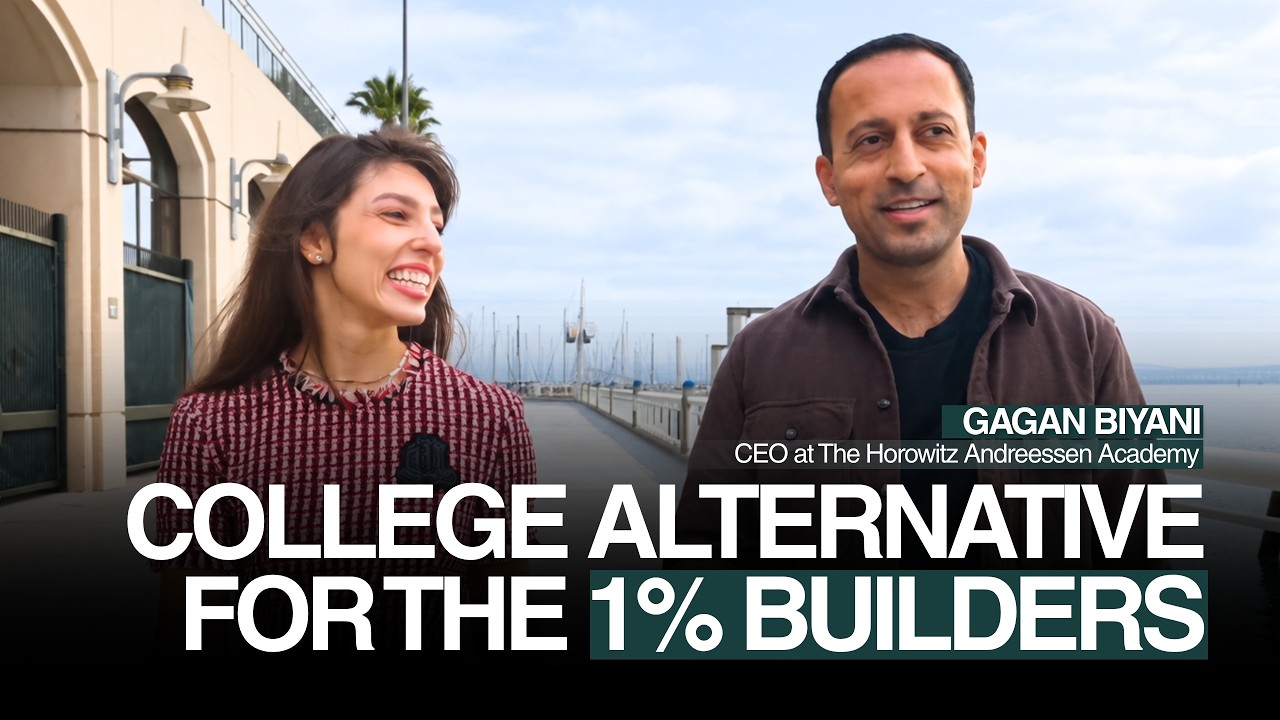
Today I walk with Gagan Biyani, founder and CEO of the Horowitz Andreessen Academy. Gagan co-founded Udemy, which grew into a multibillion-dollar public company, built Sprig, co-founded Maven, and started his first profitable business at 13, and now he's building a16z's new school for young builders, backed by $42 million. He gets into the $60M company he had to shut down, why his investors backed him again anyway, and why a Harvard dropout means nothing to him.
- Starting a debate camp at 13 that ran 50% EBITDA margins, and landing in the principal's office for it
- Sprig: $60M raised, 1,300 employees, a shutdown, and investors who backed his next company anyway
- Why the Academy flips college around, with students building instead of attending class
- The call from Andrew Chen and ten meetings with Marc Andreessen and Ben Horowitz that became the Academy
- Why he tells 18-year-olds that raising VC is a ten-year commitment
Chapters
- Trailer
- Gagan Biyani, Founder & CEO, Horowitz Andreessen Academy
- A one-year fellowship built around building, not class
- The three skills that are AI proof
- Grandparents from Rajasthan who never finished high school
- Starting a debate camp at 13 with 50% margins
- Why schools are afraid of student agency
- Seven jobs, three years, and rarely going to class
- Why most professors don't care about teaching
- What Udemy and Maven taught him
- Raising $60M at Sprig, shutting down, and getting backed again
- Why raising VC at 18 is a ten-year commitment
- The call from Andrew Chen that started the Academy
- Why the best builders will pick a16z over MIT or Harvard
- 50 founding students, tuition-free
- Why a Harvard dropout means nothing to him
- Outro
About the guest
Full transcript
LubaThank you so much for coming on the show.
GaganThanks for having me.
LubaAnd huge congratulations on the Academy. So you co-founded Udemy, which is now a $2 billion company with over 10 million students. You've also co-founded Maven, that coined cohort-based courses here in tech in San Francisco and beyond. And now you're building the Academy, the Horowitz Andreessen Academy. It's huge.
GaganYeah, we're super excited. I'm pumped up. We're gonna help dozens of young builders, you know, create their dreams.
LubaTell me, what is the Academy? What's the vision?
GaganYeah, the Academy is a school designed specifically for young builders out of high school. So when they graduate high school, they can come to the school and learn how to make things and build things and provide value to the world.
LubaIs it for people who want to start companies or for people who want to work at companies?
GaganIt's both. You know, nowadays it's kind of indistinguishable. You can go work at a big AI lab and have a super entrepreneurial role, or you can go start and raise money for your company. And I think what makes a modern technology business, you know, the business of technology, so exciting is that the skills necessary to be a great entrepreneur actually heavily overlap with the skills necessary to be a good employee or executive or a fast-growing leader within a company.
LubaSo give me a little more detail. How long is it? What's actually happening day to day at the Academy?
GaganYeah. So today what we're announcing is a one-year founding class fellowship. And so that fellowship is one year, 12 months. And eventually what we're going to do is launch a two-year school, a two-year program. And so the idea is that over the course of these 1 to 2 years, you're going to be spending time building things instead of attending class.
So there are classes. But if you think about, like, typically a modern entrepreneurial college student, right? What they're doing is they are, like, being forced to attend a lot of classes, do all their homework, all these assignments, tests, etc., but all they want to do is go and build things. That's how I was in college, and I think that's how a lot of really talented people... like, the most talented people in college are the ones who are actually spending their time creating things on the side.
And so we flipped it around. We're still going to have some of the best practitioners in the world come and teach how to do things like build product sense, create AI-native architecture, you know, learn new media, like the skills that you have, right? We're going to make sure that they have those skills taught to them by some of the best people on the planet. However, the vast majority of the time they're going to spend is going to be actually creating real things. And they're going to be their own projects.
That's the other thing that's really important, because our goal really is to develop humans with three main characteristics. The first one is AI-native building, right? So the systems thinking that's necessary to create big, valuable products for the world in an AI-native ecosystem, right, using the tools and the capabilities of today.
The second thing is we want our students to have high agency. So high agency is this idea that you can control the world around you, or you can at least influence the world around you, by taking ownership of what happens to you and your impact on the world. And I think that one of the biggest challenges you have in school is school tells you what to do. In order to get a good grade, you have to do X, Y, and Z. There's a very strict rule set, and that rule set implicitly actually creates a negative loop, which is that people are used to becoming rule followers rather than high-agency, high-ownership individuals. And so we want to flip that.
And then the third thing we're going to teach is people skills. Because what matters more in the age of AI than being able to have a good conversation, tell a story, get people excited and rally them around you? And so I think that a lot of people assume that AI schools means that you just, like, have an AI tutor that you're using. Like, we don't believe that at all. Actually, we believe that the best AI-native school is one that ensures that you use the technology to build things and create things, but actually that you need to learn the skills that are AI-proof, right? And people skills is one of those.
LubaThis reminds me so much of my most favorite class that I've taken in college. So I went to University of Waterloo in Canada. But in the third year I spent a year at Technical University of Munich on exchange.
GaganCool.
LubaAnd there I took this iOS Practicum, and that was a hands-on course where they taught you how to build iOS apps by pairing your team up with a real-world company. We were working with Bosch.
GaganYeah.
LubaWith, like, four other students, and we had to come up with the idea of what we're gonna build for Bosch. They didn't give us, you know, a task and an assignment. So we came up with this app for them using beacon technology. It was something that Apple had created back in the day. You could, like, recognize what items there are in the store. And then we had to give them a presentation about this app, and they actually ended up incorporating it into their products. And this was, like, so cool and hands-on, because you're actually building for the real world and for a real company.
GaganYeah, that is totally what we're trying to do. But we want the entire school to be about that, right? And I think the other thing that's really important is, what if you're surrounded by the best builders in the world, right? So everyone says, what is the point of college? College is about meeting some of the best network and people that you'll ever, you know, be friends with and that will go on to do great things. Well, nowadays, I think that the best builders in the world don't feel like they get that anywhere. And so what we're trying to do is attract the top, top, top 1% of those who are good at making things and bring them all in one room and have them feed off of each other.
LubaSo this brings me to a question. Who is this not for?
GaganYeah, it's not for people who want to be told what to do.
LubaOkay.
GaganYou know, like, honestly, we're doing everything we can to resist the traditional structure of: you show up and we give you an assignment, we give you a project, we tell you how you can build things. This is for someone who's a self-starter, an autodidact, someone who feels like, hey, I spend so much time kind of bored in class. And it's not because I don't like it when there's a really amazing class. Like, the best classes are still fantastic, but if it's not moving at my speed, I'm bored and I need to move on. I need to go and build things and do things. And so it's not made for people who have a very different perspective on that. They kind of, you know, they like the status quo.
LubaSo I feel like that is very much you. That's been you throughout your entire career. So I want to bring it back to you and talk about your background. Tell me more about the value of education in your family.
GaganYeah. I mean, so, you know, two generations back, none of my grandparents, all four of them, have college degrees. Most of them didn't finish high school.
LubaAnd where was this?
GaganThis was, like, in villages throughout the state of Rajasthan in northern India. So I was very lucky. On my dad's side of the family, education was just literally the most important thing you could possibly do. And so my dad became a software engineer and moved to the United States. And, you know, my mother basically raised me. My dad left the house midway through. And so for my mother, who raised me, like, the only thing that mattered was getting an education.
LubaGoing to a good college.
GaganGoing to a good college. But, you know, what's funny about that is I also learned to break the rules a little bit. Because of this rift in my family, it created a lot of need for me to step up and become kind of an adult in the family at a very young age. And so...
LubaFor example, how were you breaking rules?
GaganWell, I would say breaking the norm. Which is, when I was 13, my friend came to me and said, hey, you know, do you want to start a speech and debate camp? We were 13 years old.
LubaOkay.
GaganLike, the kids we were going to teach... I was like, who are we going to teach? We're 13. He's like, we'll teach 12-year-olds.
LubaSmart.
GaganI was like, great. Turns out we actually had some kids our own age that year in the camp. So we were just teaching our friends, basically, and usually the year younger. And slowly over time, that turned into, like, a business, right? Technically, it was a nonprofit. Technically, we were raising money for our school, so we didn't actually make revenue, you know, to my bank account. But it was a business. We had customers. We marketed it. We charged for it. We were wildly profitable. You know, we had like 50% margins, roughly.
LubaYeah.
GaganAnd by the way, that's not, like, gross margin.
LubaLike tech margins.
GaganNo, no. That's, like, EBITDA. You know what I mean? So we had, like, 50% margins and we used all that money to fund our speech and debate program.
But the thing that became a rule-breaking thing was, this was awesome, right? Like, I was 13, 14, 15. I was doing this every summer and we were teaching, like, dozens and then eventually 50 to 100 kids per summer, you know, all at once. Just imagine this huge school, essentially, right? And it was like 2 or 3 weeks. And funny enough, the adults who were around us were doing everything they could to stop us. I mean, this is crazy to me. Like, I didn't have a single person other than my mother, bless her for this, who actually said, like, Gagan, this is a good thing that you're doing. Like, you should keep doing it. Let me help you.
No, the exact opposite reaction. The reaction I got from the school was, you know, hey, is this violating some sort of rule we have? Like, have you thought about the liability? Not, hey, can I help you? This is awesome. Let me help you figure out how to make sure that it's legal and everything else. And of course, by the way, we actually had a pretty solid understanding of this, and so we had done some good stuff. But they, as adults, were constantly fearful of progress and change and challenge.
And so, honestly, I spent a lot of my high school years in the principal's office. I became on a first-name basis with the principal and vice principal, and they would frequently target the speech and debate team, of all things. Like, we're the nerdiest kids on the planet, right? Like, even my predecessors on the speech and debate team were also in the principal's office regularly.
And by the way, we ran the number one speech and debate team in the country my sophomore and my senior year. We were the best team in the entire country, right? We were competing with private school kids with $500,000-plus budgets for their programs, with multiple coaches, all their travel fully paid, etc. And we were a bunch of public school kids who really didn't come from wealth, and therefore, like, scrounged our way and built things like this fundraiser, you know, this annual fundraiser to fund our program. And even with all of that, we still were able to win. But our school was completely unsupportive. And so ever since then... and then I went to college, I went to UC Berkeley. I really enjoyed UC Berkeley. I mean...
LubaWhy do you think, just on that point, why is it that adults have such a problem with agency?
GaganWell, you know, agency is hard to control. I mean, it's, like, obvious, right? But there's a lot more risk associated with having kids that have high agency. They might do things that are risky. They might do things that, you know, cause problems for you. And as a school or as an administration, you are really worried about problems. And so as a result, the culture of most schools of any kind, whether it's a university or a high school or whatever, is fundamentally to sort of reduce the agency of their students so that they can reduce liability for themselves and so that they can have a more predictable experience.
The problem is that it doesn't actually work that way, right? The whole point of being a teenager is that you're starting to wrestle with what it's like to be an adult. And who more are you going to wrestle with than the adults who are trying to enforce their adult positions on you? And so one of the things that I think has, you know, become very obvious in literature and parenting is, like, successful kids need supportive parents. So look, if a kid is going to break a rule, you should talk to them about it. I'm in no way in favor of, you know, violating the law, you know, doing anything that's untoward towards other people. But at the same time, you have to have some appreciation for the fact that the younger generation's job for society is to take society forward. And that means changing things a little bit. That means questioning the status quo.
And so one of the things I think the Academy is going to do that's very different is actually just cultural. I'm glad you asked, because you've allowed me to explain this, because it's a very difficult thing to explain. It's like, culturally speaking, the most successful employees at companies... so let's ignore entrepreneurs. But even just the employees are the ones who recognize the right rules from the wrong rules and then go through and make the right moves within an organization to ensure that the organization succeeds, irrespective of the internal politics or the internal machinations of the organization, right? So if you want to be a really successful employee and you want to deliver great products, you have to be somewhat maniacal about delivering value to the end user.
Now, if you've spent your entire life, and the culture of the schools you've gone to has been, hey, actually, the rules matter more than what's right, right? It doesn't matter what the end product is. What matters more is just doing what I say. As you slowly build that, the challenge you end up having is that you are used to accepting the trade-offs of the rules versus, like, what's good for the customer.
And obviously there's a balance there, just to be clear. We're not pro rule-breaking, but we're pro having a good reason and having a conversation with the student about it. So if a student decides to do something like hack into the school's software, we're absolutely going to talk to them about that. Like, that's not okay. If they're going to go out partying too late and they're going to miss class, like, we might have a conversation about that, I don't know. It depends on the context, right?
But I think for the most part, that's the type of thing where, if you manage that with grace and with supportiveness, you can create people who understand that being a part of society is a critical aspect. You need to respect others, the people around you, etc. But you can also build amazing things by thinking a little different. And that balance is something that is not part of the culture of most colleges. And it's definitely not part of the culture of most high schools. And so when you get out of high school and you finally have a lot more freedom, we believe it's critical for that type of student to have the opportunity to flex a little bit of that freedom, and to see it in a contained environment, so that they're not just flexing in the real world. Because the other thing these students do is they just drop out and start companies.
LubaAnd let's actually bring it back to you. So you went to college. You didn't drop out.
GaganThat's right. Yeah. Well, I had no idea you could drop out. I mean, honestly... and I did kind of try. I talked to my mom about this one.
LubaOh, you did?
GaganI had this startup idea. But I didn't know what a startup was. It was just, like, a business idea in my mind. I didn't know what venture capital was, even though I went to UC Berkeley. Like, that doesn't mean that you're going to be part of the circles that know these things. Most people there were just, you know, trying to get a job in banking or consulting or something like that.
And so I did go to UC Berkeley, but in a lot of ways, I didn't go to UC Berkeley, because I didn't follow any of the molds. I had seven jobs. I graduated in three years. I rarely went to class. I had some classes that I loved, so if the class was great...
LubaA class you loved?
GaganOh, I loved my teacher for Econ 1, Professor Olney. She was amazing. I attended every single class, you know. But there are lots of professors in school, and this is something everyone kind of knows but no one talks about, is, like, most professors are there to do research. They don't care about teaching.
LubaAnd they're not practical.
GaganYeah. Oh, and they are not practical at all, right? They've never worked a day in their lives for anything other than this, like, very, very insular institution. And so I think there are some great professors at all schools. But one of the things that I think is important is the Academy is going to have practitioners, people who have actually not just worked a day in their life. They've spent a decade or two decades building things at the leading companies.
And I think that people will find that they are far more qualified educators for the future of society than the educators who have seven years doing research on a very, very narrow subject, where they might be the world's best at that specific subject. But we're not talking about psychology as a subject. We're literally talking about, like, you know, the psychology of chimpanzees in Western Africa, right? Being that specific and having done a PhD in that level of detail does not prepare you for sharing with students, you know, how they should use psychology in the workplace.
And so instead, you know, I have a friend, Kristen Berman. I'm hoping she'll teach. She'll certainly come speak at the Academy, but I'm hoping she'll teach a class of some sort. And she's a behavioral psychologist, and she works with all the top companies to help them with behavioral psychology. And I think she is both an academic in a sense, because she writes papers, she reads, and she's also a practitioner. And that's the type of person who I think is going to teach at the Academy.
LubaOkay. So you went to Berkeley, and then where did your passion for disrupting education really start?
GaganI think it started in high school, actually. So another story: in junior high, middle school, I was ranked, like, the number two student in the school. So we had these awards at the end of the year, and I got the second most of them in the school. And so I was a really, really good student. And when I got to high school, I started to ask, like, why am I doing what I'm doing? Whatever I was doing, I was starting to think more critically about it. I think lots of students do. What was it for? Why am I doing this? Is this actually serving my education?
And I also think that, candidly, my junior high teachers were just better than my high school teachers. So I think if I had my junior high teachers, I would have had a different experience, maybe. But for me personally, what ended up happening was that a lot of my classes were extremely bad. Like, I remember going to Spanish class... I would say I was close to fluent in Spanish after Spanish 1 and 2. Language just came very naturally to me. And one of the reasons was because we were taught Spanish through Spanish immersion. And language immersion is, you know, by far and away in the research, the best way to learn a language.
LubaI'm actually about to go on a week-long Spanish boot camp immersion in Mexico, because I really want to learn Spanish.
GaganSo incredible. So the thing that you might know about this is, well, my teachers in junior high were so good. You know, as soon as you entered the classroom, there was no English in the classroom, even though it was Spanish 1, right? We didn't know any Spanish, you know. Maybe we had picked up the word "hola" when we were kids, you know? Or "ándale" or something. But we didn't know any Spanish. But the act of immersion... and I took it seriously. Like, I really wanted to learn Spanish. I loved it, and so I learned Spanish.
Then I get to Spanish 3 in high school and the teacher's speaking in English. And I was like, what's going on? And then, by the way, not only are they speaking English, they have these weird, like, completely insane tests. Their tests were essentially, can you memorize, like, 20 quotes? Like, random quotes that no one uses today. And, you know, I've been to all these countries, right? Been to Colombia, Spain, Mexico, etc. And no one says any of these quotes. These are just random literary quotes. And the idea is that you had to memorize them, not understand them, not talk about them, not discuss them in Spanish.
And so I started to see that there was a difference between good schooling and bad schooling, and not all schooling is inherently good. I started to notice, and I'm sure parents notice this all the time, that not every one of their kids' teachers is actually high quality. So the question is, like, why? If you're at a top-tier institution like UC Berkeley, why is it that half my professors are, honestly, like, illiterate at teaching? We're not talking about teachers who are just like, oh, they're okay. It's like, no, you're literally sitting there and you're like, dude, I'm learning almost zero, and I care. And so, by the way, again, there are plenty of professors who are excellent. Like, I loved half of my classes, and half of them I didn't.
So, like, why is this true? Well, because the incentives of both secondary school, the incentives of high school, and the incentives of higher education do not optimize for the student's experience, right? There are too many other people who are making decisions about what our students should be like, about what should happen in the school, that are not focused on our students.
And so as a result, I personally really started to become concerned with the fact that, while I was an autodidact and I was the type of person who could navigate this very complicated environment, I saw a lot of my peers not learning nearly as much as I felt we could have. And I had some of the best peers, and I have a really close relationship with my friends from high school and college. And so, honestly, I've just always been frustrated by that since then.
So yeah, for me it worked out, because I was able to sort of muddle through, and I taught a lot of my stuff myself. I basically took college by the horns and did something totally different. But it's like, what if you'd created an environment for someone like me that was actually, like, you know, supportive? And so I personally didn't feel supported, you know, in high school and in college, by the system. I certainly felt supported by my friends and by my parents. But I didn't feel supported by the system. And that's why I've always wanted to improve it, to make it more student-centric.
LubaAnd then you had a couple of shots on this goal. You went on to start Udemy and then you went on to start Maven. What are the lessons that you've learned at both that are inspiring your journey with the Academy?
GaganYeah, I'd say we had shots on goal. Some of them hit the back of the net, so I'm proud of that. I think that what I've done with Udemy... with Maven, sorry, with Udemy, let's start with that. My co-founders had this idea of democratizing education and making it possible for anyone to learn anything at a very, very low cost. And, you know, we created the largest, or second largest, because Coursera and Udemy are different depending on what metric you look at, but the largest education site on the planet. And, you know, everything's like $10 to $20. It's kind of amazing.
And we were able to do that by harnessing and understanding how the internet works, right? Speaking of learning about the industry and AI. And then also having a deep passion for education. So we combined those two things and provided people with access. And, you know, Udemy today, I get emails still regularly from people who are like, wow, I took a course on Udemy and I got a career in programming. Like, this is such an incredible feeling, right?
LubaYeah, it's crazy that the courses are like $10, $15, because they're really elaborate and some are multiple hours or tens of hours long. I remember when I was learning programming, I think I took a couple of Udemy courses too, and I was like, how is this so cheap?
GaganYeah, yeah. I mean, honestly, the great thing about digital content is once you create it, you know, there can be a thousand people, a million people who access it. And so, you know, if a million people spend $10, it's still a lot of incentive for the instructor. And so I think it was, like, a really amazing combination of understanding of sort of marketplace dynamics to be able to provide an affordable good at a time when access to that type of education was super rare, right? Like, at that time, YouTube didn't even have much education content. And so I'm super proud of what we did at Udemy.
LubaI know that Udemy didn't end up the way you personally wanted. There are a lot of personal lessons from it. Could you give some context on that and what you learned about yourself as a leader and what you could do better?
GaganYeah, so I think two things happened that are somewhat unfortunate. You know, first of all, my co-founder and I had a falling out, and so I left the company about three and a half, four years in. And that was really disappointing, because I would have loved to have been a part of more of the journey. And I think that was a lesson in interpersonal skills, which is why interpersonal skills is such a core tenet, right?
So for me, I learned that being aware of my colleague as a stakeholder and as a human being, and my other colleagues, is a critical component of being successful. And again, no one taught me that, right? Like, I was in all these schools, I was running these organizations, and no one was like, hey, Gagan, you know, some of your fellow students don't really like interacting with you, and you should, like, work on that. You can solve that problem. That's not a permanent state of who you are. But instead, I had a lot of teachers... or certainly I remember the vice principal, she literally told me in school, like, out of the office, she's like, this will be your downfall. I'm like, dude...
LubaInstead of giving you some practical feedback and telling you...
GaganYeah. I was 16 years old. Like, teach me something, you know? Like, I want to learn. And so of course, eventually I did learn, and I think I've become a more effective manager. You interviewed at my company. I'm sure you saw that, you know, people liked working there, and people like working at Maven. And I'm still friends with almost everyone at Udemy as well. So we figured that out, but I think it was a hard lesson for me.
LubaYeah. I would say you were definitely more effective at it. And for some context, I applied for Sprig. That was one of my first software engineering internships. I actually ended up getting an offer, but because it was my first internship, I ended up taking, like, a bigger name...
GaganAnd more established.
LubaA more established company. But you were so great at sales. Like, you spent so much time with me on the phone convincing me to work at Sprig and how amazing it was. And I was like, damn, this guy... Like, I think you were maybe 26 or something at the time. Such a good, effective sales communicator.
GaganThank you.
LubaSo clearly, it's some of those lessons you've learned from either Udemy or your prior days in speech and debate.
GaganYeah, and I think the real lesson that I needed to learn about sales was that sales is obviously about people. And you have to keep selling every time you interact with someone. So it's not just about selling someone when they get into the internship. It's about, like, constantly thinking and empathizing with them and what they need, so that you can be meeting them where they're at. And I believe strongly that those who are more empathetic become better humans. And it serves yourself, because you start to develop more humility in yourself when you realize, like, we're all kind of the same, you know? We all have the same motivations. We all have similar desires. And so you can start to see yourself in other people as well, which creates even more connection.
LubaSo Udemy didn't work out as you expected. You then go on to start Sprig. Sprig was a food delivery company that also made the food for you. It was, like, one of the first movers here in the Bay and in other cities, pre-Uber Eats. What went right and what went wrong that taught you lessons about being a leader?
GaganWell, I think from a leadership perspective, you know, you can't just be good at raising money and selling. You also have to have the right idea. And unfortunately, Sprig was not quite the right idea. You know, it was a really cool concept. People loved eating our food. We fed, like...
LubaIt was very delicious.
GaganYeah. The cool thing about this is, so there's two different sides to this. You know, one side is we tried to build too much, it was too capital-intensive. So we tried to build full kitchens in the center of San Francisco, you know, that were delivering food to everybody. And so we were soup to nuts, both managing the delivery workforce as well as, you know, running the kitchens and having 100-plus people in the kitchens. At one point we had, you know, 1,300 employees on payroll. We became the largest restaurant in San Francisco, or second, somewhere in that range. And so, you know, we very much learned that, yeah, you have to have the right idea. Like, the idea has to be the right idea for the market, and the capital structure has to be right, because when you're raising money from venture capitalists, you have to grow at a certain speed, etc.
The other thing I learned is the Valley. Silicon Valley is the greatest place on Earth. And I think a lot of people think of the Valley and the stories being told about the Valley. But if you actually ask anyone who's moved here, right, it's an extremely kind and forgiving and thoughtful place.
LubaYeah. One way I like to think about it is that even if you fail, you fail upwards. And that's very rare.
GaganYeah. Very rare.
LubaActually, this reminds me that when I was in Munich that year, when I was transitioning into tech, I went to some startup events there, and one that stood out was this event with four people who were quite a bit older. They opened up a Q&A, and the question from the audience was, what's your one piece of advice to startup founders? And this lady goes, one piece of advice that I have for you is that you should never fail. You should make sure that you never fail. And I was like, oh my God, this is such a different mentality from Silicon Valley.
GaganYeah. So as you know, Sprig raised about $60 million and eventually shut down, right? And what I am so impressed with is that, like, a significant percentage of my investors in Sprig invested in my next company, Maven, and they were happy to. And in general, because I had, you know, taken a big swing, made a big impact on a market, you know, I'd done work that people were excited about, people were supportive, and I was able to sort of fail upward. I was able to continue with my career, not as though nothing happened, but rather as though something good happened.
And that's crazy. When you lose, you know, 50-plus, because we returned some money, $50 million of investor capital, for them just to say, hey, we're still going to support you and root for you in whatever you're doing next. That is a shocking thing for anyone in the business world. That's not how most companies operate. Most companies operate where if you make a big mistake, you get fired, right? Or at least you don't get promoted. But actually, in Silicon Valley, you get promoted for doing something bold that might have a chance of being successful, because we understand that true success is super rare.
LubaOkay, so after Sprig, you shut it down, you decide to come back to education with Maven. What was Maven? What was the vision?
GaganYeah, I think I realized education is just where my heart is, right? And I think it's where I have more product-market fit. So Maven is, essentially, today, an AI training website. It's got some of the best practitioners in the country, people who work at OpenAI, Anthropic and all the other leading technology companies, or who have worked there in the past, teaching the next generation of young professionals. So if you're in your mid-20s or mid-30s and you want to get up to speed on AI, Maven has courses that are super specific in each field.
One of the things about AI is it's actually, like, not just learning ChatGPT or learning how to prompt. Every micro-skill is different. So what a sales engineer needs to do is different from what a salesperson needs to do. What a go-to-market leader might need to learn is different from what a recruiting leader might need to learn. And Maven has specialized courses in every area and every function that help you learn how to use AI in the workplace, and then also to learn the people skills that AI cannot really teach you. And so there's a lot of great leadership courses as well on Maven that are still to this day quite successful.
LubaYou were working on Maven for six years. It obviously grew into what it is right now, with AI, leadership, practical courses. Why not continue what you're trying to do now at Maven? This is your baby. It's your company.
GaganYeah, yeah. I think Maven has its own trajectory right now, and it's super exciting. Like, Maven is becoming the platform for businesses now to train their employees on AI. This is a huge problem in the enterprise. And if we tried to smash that in with the idea of the Academy, it would have required us to focus on one or the other. We couldn't do both at the same time, at least not at the scale... you know, these are both smaller companies.
And so I think it's actually a really good win that my former VP of product, now CEO, Ryan, was already at the company, was running the vast majority of it at that point. And so it was just like, hey, Ryan, why don't you go after the B2B opportunity in helping enterprise? And then I'm going to go after the, you know, young adult market and sort of provide an alternative to college without a four-year degree, right? Like a two-year program for the most ambitious young builders in the world.
LubaAnd so did you have this realization that actually you cared more about the young builder versus your peer contemporary?
GaganOh, I just think I care about them all. I think what I've realized is I've been every one of those people, right? I've been the young builder when I was 13 or 16. Maybe eventually I'll do something in high school, I don't know, you know. And so it's not a prioritization thing. The great thing about business in the world is you can go and make impact on many things over many years, and you don't need to, you know, say one is more important than the other. You can just say each of these are things that the world really needs in order to move forward. And I think that Udemy, Maven and the Horowitz Andreessen Academy are all three different instantiations of me and who I am and what my vision is for the future of education in this world.
LubaA lot of entrepreneurs, startup founders have attachment to this idea as my idea. I'm building it from scratch. This is, again, my baby.
GaganYeah.
LubaWhy go and partner up with a bunch of successful people in the Valley to build the Academy versus, again, continuing to do something on your own?
GaganGreat ideas are rare. So in today's world, it's very easy to raise capital, even for young people. You know, I have lots of 17-, 18-year-olds that I meet who are like, why don't I just go start a company? And I'm like, well, honestly, starting a company and taking money from venture capital is a ten-year commitment. And that's a very, very serious commitment. You should only do it when you really have an amazing idea, and...
LubaAnd also when you're sure that you want to spend the next ten years on it. And a 17- or 18-year-old, they just don't know who they are yet.
GaganExactly.
LubaThat's a really hard gamble.
GaganYeah. And so that's why the Academy exists and why I thought the idea was great, because I think there are a lot of young builders out there who are looking for what's next, and they would benefit from and enjoy a peer network of other people who are as amazing as them. And who better to get that peer network together than Andreessen Horowitz, the biggest and greatest venture firm in the world, right?
LubaSo take me to that moment. Was it, like, Ben calling you, Marc calling you, like, hey, we're starting the Academy? What was the conversation?
GaganYeah. So actually, my board member at Maven is Andrew Chen. And so Andrew called me.
LubaAndrew. Yeah.
GaganWe have, you know, a regular call, and Andrew's like, hey, there was this idea that's been kicked around called the a16z Academy. That was the name at the time. And we've been talking about it, and we were thinking about spinning it out, and we'd love to, you know... And so I just immediately, when I heard the idea, I heard, like, one sentence of the idea, I said, I want to do that. I want to hear about it and learn about it and figure out what it would take.
And of course, I had to figure out how that would interplay with Maven. And so I was very lucky that we were able to come up with a solution that, you know, was really... honestly, I'm pretty optimistic. Ryan might be a better fit for CEO than me for this company. I think his experience in marketplaces, understanding of product and his ability to go and sell B2B, like, he just has a very unique intersection of all three of those things. I'm more of a marketing person than a sales person. I can do both, obviously, but I think that he's a really, really good fit for Maven. I'm very, very excited about it.
And so anyways, so Andrew and I have a call, and then you have the meetings with various people at the firm. And so I met with Jason Rosenthal, who had been shepherding this project, and then Erik Torenberg, who was also shepherding this project. And then of course, I met with Ben Horowitz and Marc Andreessen, and I think we probably had, like, ten meetings. You know, I had multiple times where I met with Marc and Ben and talked about the vision and kind of figured out, like, are they serious about this? Like, are they willing to put their network behind this? Because the thing that makes this really work is the fact that Ben and Marc have built a16z to be a network.
And so there's two different networks that you need as a successful sort of, you know, student. One is you need the network of peers. So you need to be able to believe that you're going to find the best builders on the planet. Like, you know, why not go to MIT or Harvard or something else? Well, our belief is that the best builders are actually going to be at the Horowitz Andreessen Academy. And then the second thing you need is a network beyond just your peers. You want mentors and other CEOs and venture capitalists and stuff. And who better to convene the most amazing and credible network on the planet than one of the biggest venture firms on the planet?
And so when I got to know that they were willing and interested, and they understood that the start of an academy for this type of ambition really requires sort of having an existing network and infrastructure, you know, I knew it had to be a partnership with them. And so, you know, Marc Andreessen joined the board, Erik Torenberg joined the board. And we've been, as a group, you know, with the wider a16z network, working together to sort of launch this. And it will be its own separate company, and probably in a year or two, it'll have its own brand and it'll have its own sort of network. And of course, we'll continue to use the network.
But what I think is really special is they've really helped activate it. And so, you know, when we launch this, after this video is posted, you'll see on our website just the absolutely insane number of legends who are involved in the Academy from day one, you know, either as investors or faculty members or guest speakers or mentors. And so I'm a huge believer that this network is going to come to bear. And the first 50 students especially are just going to be so lucky, because the founding class fellowship, first of all, it's tuition-free. It's, like, the only one that's going to be tuition-free, probably. And then also, they're going to get a front-row seat. So it's gonna be a little more chaotic for them. They have to be more entrepreneurial, more builder types, than the next classes. But also the upside is huge. This could be, like, a magical moment in educational history, I hope.
LubaI want to come back to the question about agency. So you have been a person with a lot of agency. You've been an entrepreneur your whole life. Now you're going kind of under the wing of a bigger institution. How do you feel about that?
GaganWell, you know, this is interesting because... it's such a great question, Luba. You know, we have constructed this... and I think this is where Ben and Marc and the firm's wisdom comes in. The firm is, you know, they're experts in how to ensure that entrepreneurs can be their own and still, like, provide value to them. And so they've assigned me as founder CEO. You know, I have the latitude. And, you know, one of the quotes that I get all the time from Erik Torenberg is, like... I need to remember it. It's, "I leave that to you." You know, "I leave that to you." Like, the vast, vast majority of decisions that we've made to date, even in the forming of this thing, have been "I leave that to you." And I think that's a reinforcement of, hey, as founder CEO, you're trusted.
And at the same time, like, I know there are certain things that I want their collaboration on. These are some of the smartest people in the world, so I am super excited. I've always had good relationships with my board, and I've always listened to advisors and investors. And so a16z is just some of the best advisors and investors I could possibly have. Like, I think it actually is a total net positive that I get to work with these people on a regular basis and learn from them.
LubaWhat are some of the things that you're worried about?
GaganWell, I mean, the most difficult challenge here is making sure that you have the best people. So our entire job right now is to recruit the best students on the planet to all come together. And I'm also a little bit worried that these students are going to come in and they're going to be like, I got into the Horowitz Andreessen Academy. Like, that's a big deal. And I'm going to be like, no, no, no. Like, what matters is what you do after this, right? You know, getting into Stanford or being a Stanford dropout or a Harvard dropout doesn't matter to me at all. I don't care. I don't have any sort of elite connection to that. I think people who are young might think that that's cool, but actually, as you become older and older, you realize, like, what matters is what you do after that.
And so creating the humility in the students that, yes, you are part of kind of this really unique moment in time where you get to be, you know, a founding class fellow with all these other students who are amazing, while also ensuring that they have the humility to just go and do the work and go and build things and, you know, enjoy themselves and, you know, make mistakes and all of that. I want to reduce pressure, basically. I'd say the biggest challenge you hear about, you know, public high schools today, the most competitive ones, is students face a lot of pressure. And I am most worried about, how do I create an environment where we have high ambition and high support, right, so that the pressure is reduced and students can really just go and be free and sort of play. Build, but play. I think that's really important.
LubaYou've been a lifelong learner yourself. What are some skills and things that you feel like you need to learn as a leader, stepping into disrupting the next chapter of education?
GaganWell, I think I'll still have to get even more patient than I've been.
LubaHow so?
GaganWell, I mean, these students are going to do things that are going to test my patience at times.
LubaThey're going to continue breaking rules.
GaganYeah. I mean, who knows? I don't have a specific idea. And I also don't want to put ideas in future students' heads. I'll let them figure it out. But they're going to make us a little uncomfortable. And I've got to get excited about it at times. And then at times I have to say, look, I know you think you're just, like, breaking the rules for the sake of breaking the rules. It's not good. Like, you should break the rules for a purpose. And by the way, breaking the Academy's rules is not going to be the same, because we're going to have a lot fewer rules, but we're going to have good rules. And so if you want to break the rules, you've got to talk to us about it. You know what I mean?
So building this balance is going to be a very interesting challenge that I'm certainly worried about, that will test my patience as a leader, and my willingness to both balance having a great institution that people respect, and simultaneously ensuring that students can sort of develop and have the freedom to explore and figure things out.
LubaWho are some people that you've been learning from over these last few years?
GaganOh, I mean, two people come to mind immediately. Obviously we already talked about Andrew Chen, so I'll leave him aside. He's been an amazing mentor to me in building Maven. And then Russ Fradin. Russ Fradin's a seven-time entrepreneur. He's had multiple IPOs, multiple exits. He's a great angel investor. And he's someone I always call when I'm in a pinch and I have something really hard going on.
LubaRuss Fradin? Like, the guy... you know, Ann Miura-Ko is a good friend of mine.
What has Russ taught you?
GaganRuss tells it how it is in a way that is incredibly warm. So Russ has figured out how to be, like, insanely direct. Like, he's just one of the most blunt people I know. But he says it in a way where I'm, like, always happy to hear what he has to say. And I think a lot of other people are. And so I've really learned through hearing advice from Russ, because I have a similar personality to him. So I can learn a lot from his grace with being both strong, but also, like, hey, it's no big deal. He's really good at having the right tone and balance.
I've also just learned a lot of tactical things from Russ, like how to negotiate with VCs or what to ask for, you know, compensation conversations, you know, all the brass tacks of building a business. So, yeah, it's really important to build that relationship with someone, and hopefully the students at the Academy will get to interact with people like Russ.
LubaWhat have you learned from Andrew Chen?
GaganAndrew is an incredibly smart strategic thinker who is also super patient. And so I'm super impressed at how effective Andrew is at breaking down a problem. And so I've learned a lot about marketing and go-to-market. And we've talked about the education space a lot. And then he's also, again, patient. He's willing to see things out, allow them to play out. And I think it's a very rare combination.
LubaAnd Gagan, just to wrap it up, what are you trying to prove to yourself in this next chapter?
GaganI want to build the greatest school on the planet. I want to prove that that's possible. You know, a lot of people, when I was younger especially, told me that, like, college is great. And I agree, by the way. College is great. I think it can be better. I think it's changing a lot with AI. And so I want to prove to myself that it is possible to create the next great institution, and that other universities, colleges, schools around the country will be inspired, hopefully, by what we're doing. Because I think that I need to prove to myself that this vision that I kind of have sitting in my brain is something that lots of other students are going to benefit a lot from.
LubaI love it.
GaganYeah.
LubaWell, we're back at Andreessen Horowitz, where we started, even though they were removing the sign today.
GaganBut they're just doing a paint job. Yeah.
LubaGagan, thank you so much for your time. Super excited for it.
GaganThank you, Luba. I really appreciate it.